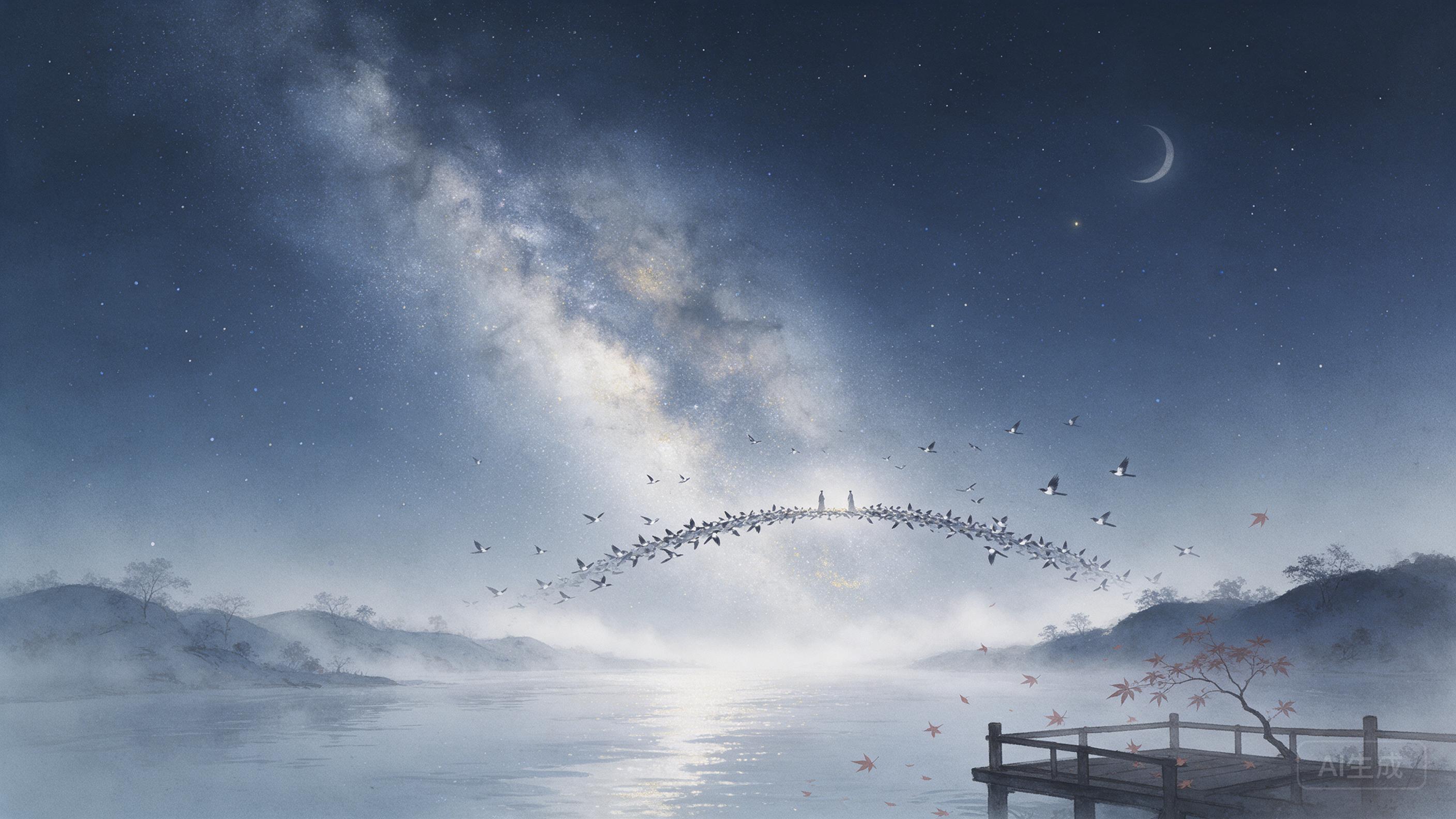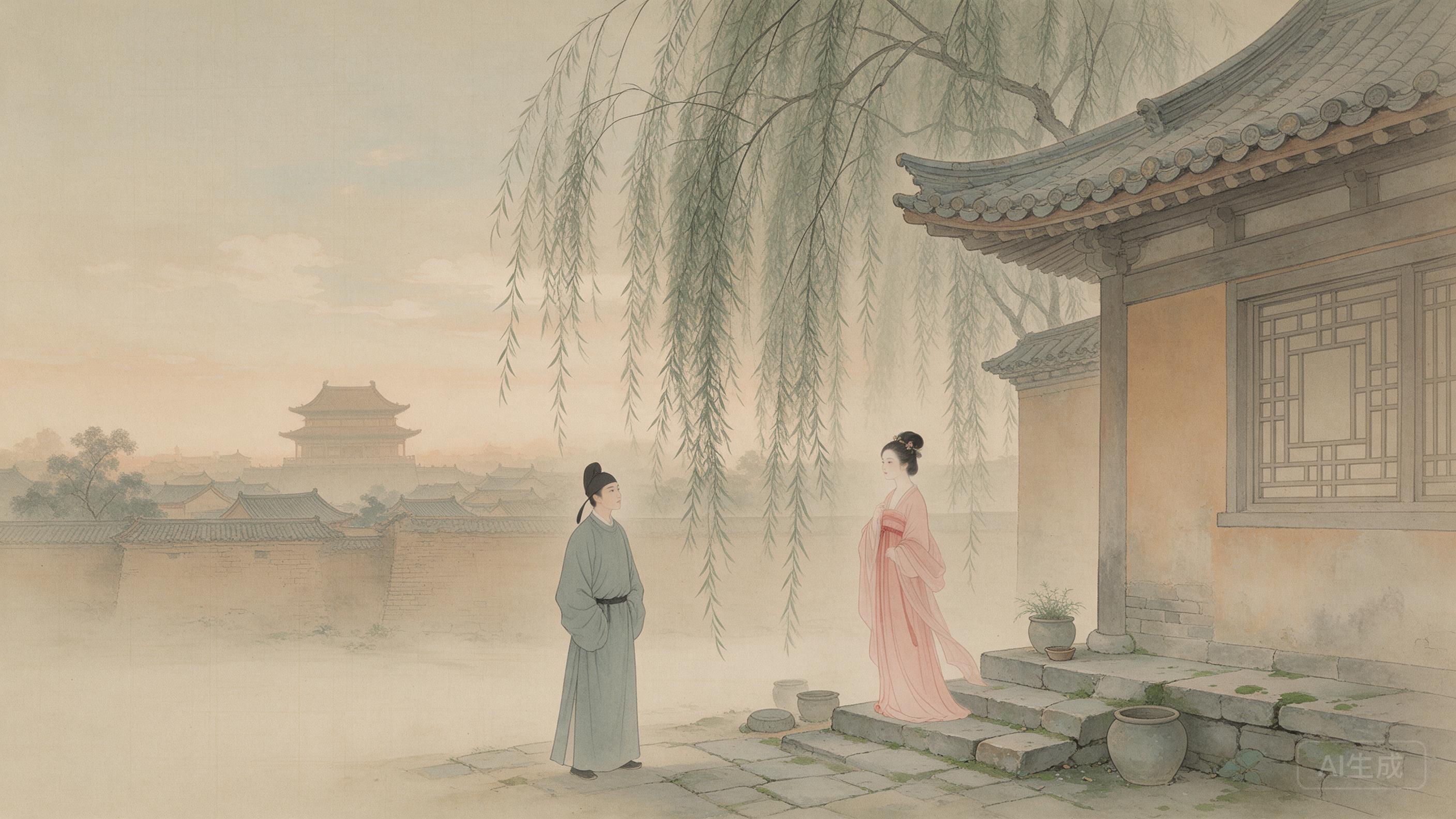
In the first month of 1075, in Mizhou, Su Shi wrote a short ci about a dream of going home. Ten years earlier his first wife, née Wang, had died and been buried in Sichuan. The poem does not give her name, does not describe her death, and says nothing about the marriage. It gives a window, a comb, a silence, and a hill of pines under the moon. This essay reads it by keeping three kinds of statement apart: what the text says, what the epitaph and the dynastic history establish, and what readers have long inferred.
Text: the poem is given in the commonly printed version, in the tradition of the Complete Song Ci (Quan Song Ci); Wikisource carries the same text. A few modern anthologies read 相对无言 for 相顾无言 and 年年断肠处 for 年年肠断处; neither affects the reading offered here. Date: the title's 乙卯正月二十日夜 is the night of the twentieth day of the first month of 1075, the eighth year of Xining; the title records a date for the dream, not proof that the poem was written that same night. Biography: Su Shi's epitaph for his wife, née Wang, gives her death in the fifth month of 1065 and her burial the following year at Pengshan, Mei prefecture; the History of the Song Dynasty, juan 338, records his move from Hangzhou to Mizhou. Interpretation: that the dreamed woman is Wang Fu rests on the title, on the epitaph's dates and grave, and on the long-established reading of the poem as a lament; the text itself never names her. The last lines' 肠断 has no stated subject, and the Stanford translation reads it as her heart breaking for him.
The Title as Evidence
The title fixes an occasion: on the night of the twentieth day of the first month in the yimao year, Su Shi dreamed, and recorded the dream. Yimao falls in 1075, the eighth year of the Xining reign of the Northern Song. The tune is Jiangchengzi, also known as Jiangshenzi, “the River God”. The title gives a date and a dream, not the hour of waking, the circumstances of writing, or the dream's meaning.
The Poem: A Working Rendering
Ten years, the living and the dead, both blurred. I do not think of you, and cannot forget. Your lone grave a thousand li away: nowhere to speak of desolation. Even meeting, you would not know me — dust on my face, frost at my temples.
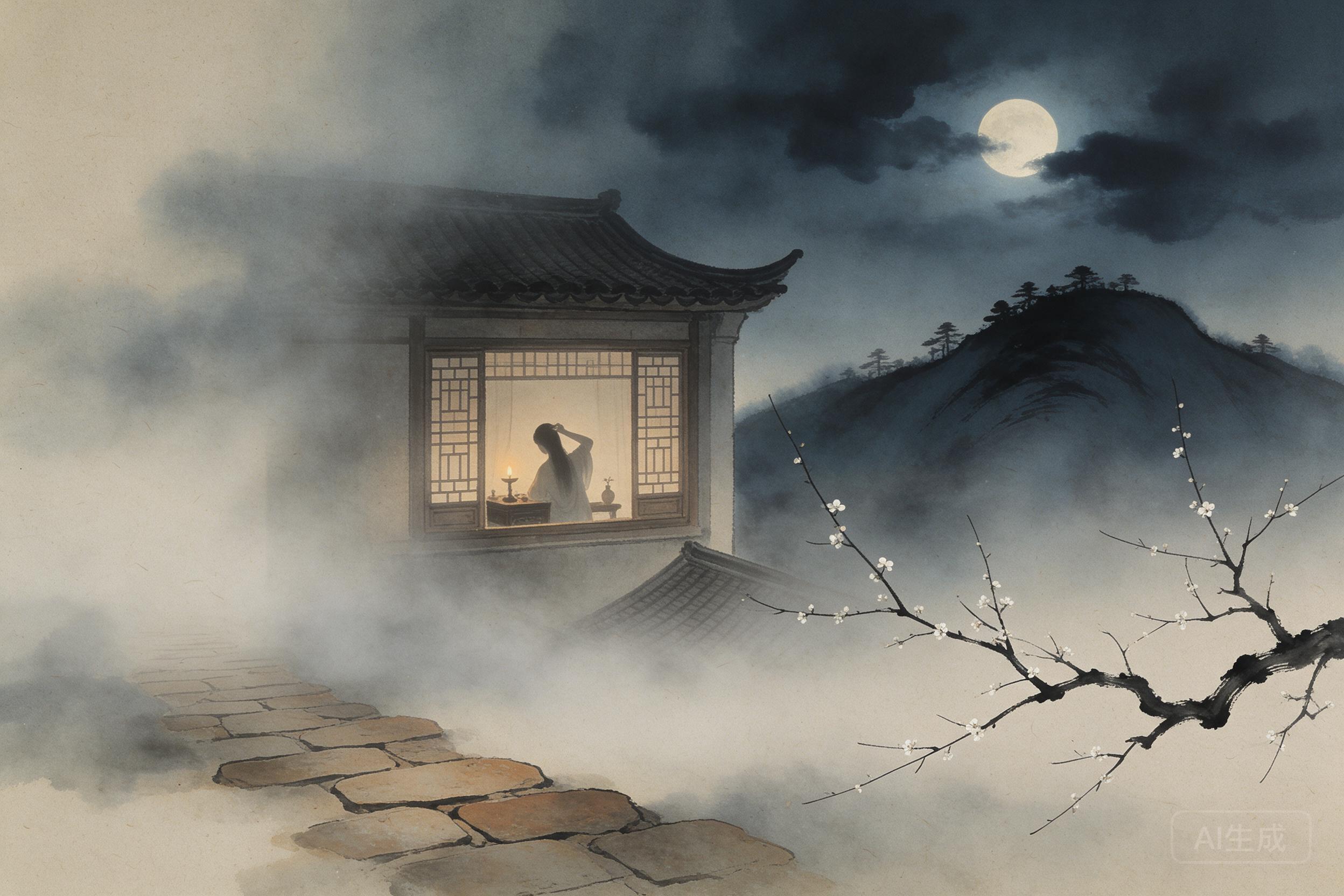
Last night a hidden dream suddenly brought me home. By the small window, you were doing your hair. We looked at each other, speechless; only a thousand lines of tears. I reckon the place where the heart breaks, year after year: a bright-moon night, a low hill of pines.
A plain working rendering, not a published translation: it keeps the order of images and drops the tune's music.
Ten Years, and Slightly Less
The poem's first word is a number. Su Shi's epitaph for his wife, née Wang, records that she died in the fifth month of 1065, in the capital; the dream is dated to the first month of 1075. The interval is a little under ten full years, and the poem rounds it up, which is how grief counts.
Distance is the other measurement. In 1075 Su Shi was at Mizhou, whose seat is modern Zhucheng in Shandong, having been moved there from Hangzhou per the History of the Song Dynasty; her grave lay at Pengshan in Mei prefecture, in Sichuan. A thousand li away is not a flourish but geography.
Who Is Being Addressed
The body of the poem never names the woman. She is you throughout; it never says wife, or Wang, or dead. The identification comes from outside: the dream the title records, the epitaph's dates and burial place, and a centuries-long reading of the poem as a lament for a dead wife. Stanford's Global Medieval Sourcebook presents it the same way in a short introduction to its translation. Within those limits the identification is solid; beyond them the poem declines to go, reporting of the dream only that nothing was said.
The Window
By the small window, you were doing your hair. It is the most ordinary line in the poem and the heaviest. The usual reading takes it as a dream return to the old house in Mei prefecture, a glimpse of her lifetime: a woman at her dressing table in morning light. Whether memory surfaces here or the dream invents a scene, the text does not say; the word rendered suddenly holds both. What is certain is the image: a window and a comb, not a grave and a shroud. The reunion imagined is domestic first, and the silence after it takes its force from that.
The Epitaph's Witness
The epitaph is short and unsentimental, and gives the woman the poem does not describe. She was of Qingshen in Mei prefecture, daughter of Wang Fang, a provincial graduate; she entered Su Shi's household at sixteen, bore him a son, Mai, and died at twenty-seven. It says she did not at first claim to read, but stayed beside him while he read all day; when he forgot a passage she could supply it, and asked about other books she knew them roughly. It also records her listening behind a screen to his talk with guests, then judging them herself. Nothing here is romantic in the later manner: it is a capable, watchful person, set down by a husband with reasons to be exact.
The Last Three Lines
The poem ends at the grave: a bright-moon night, a low hill of pines. The hill is the burial place, and the lines are usually read as the poet imagining her grave on a moonlit night, alone in a landscape he cannot visit. The grammar leaves open whose heart breaks: the place where the heart breaks does not say. It can be the poet breaking year after year for her, or her breaking year after year for him; the Stanford translation takes the second. Both are possible, and the poem does not settle it: a disagreement among readers, not a gap that research will close.
The poem keeps what a dream keeps: an ordinary morning, then the distance, then the count of years.
Sources & further reading
- Su Shi, “Jiangchengzi: Recording a Dream on the Night of the Twentieth Day of the First Month, Yimao,” Chinese text, Wikisource
- Qian Jia (trans.), “To the tune ‘River God’—Recording a Dream on the Night of the Twentieth of the First Month of 1075 CE,” Global Medieval Sourcebook, Stanford University
- Su Shi, “Wangshi Wang mu zhiming” (Epitaph for the late wife, née Wang), Chinese text, Wikisource
- “Song Shi (History of the Song Dynasty), juan 338: Biography of Su Shi,” Chinese text, Wikisource
- Sun Jiye, “Su Shi and Mizhou,” Guangming Daily, 10 September 2023