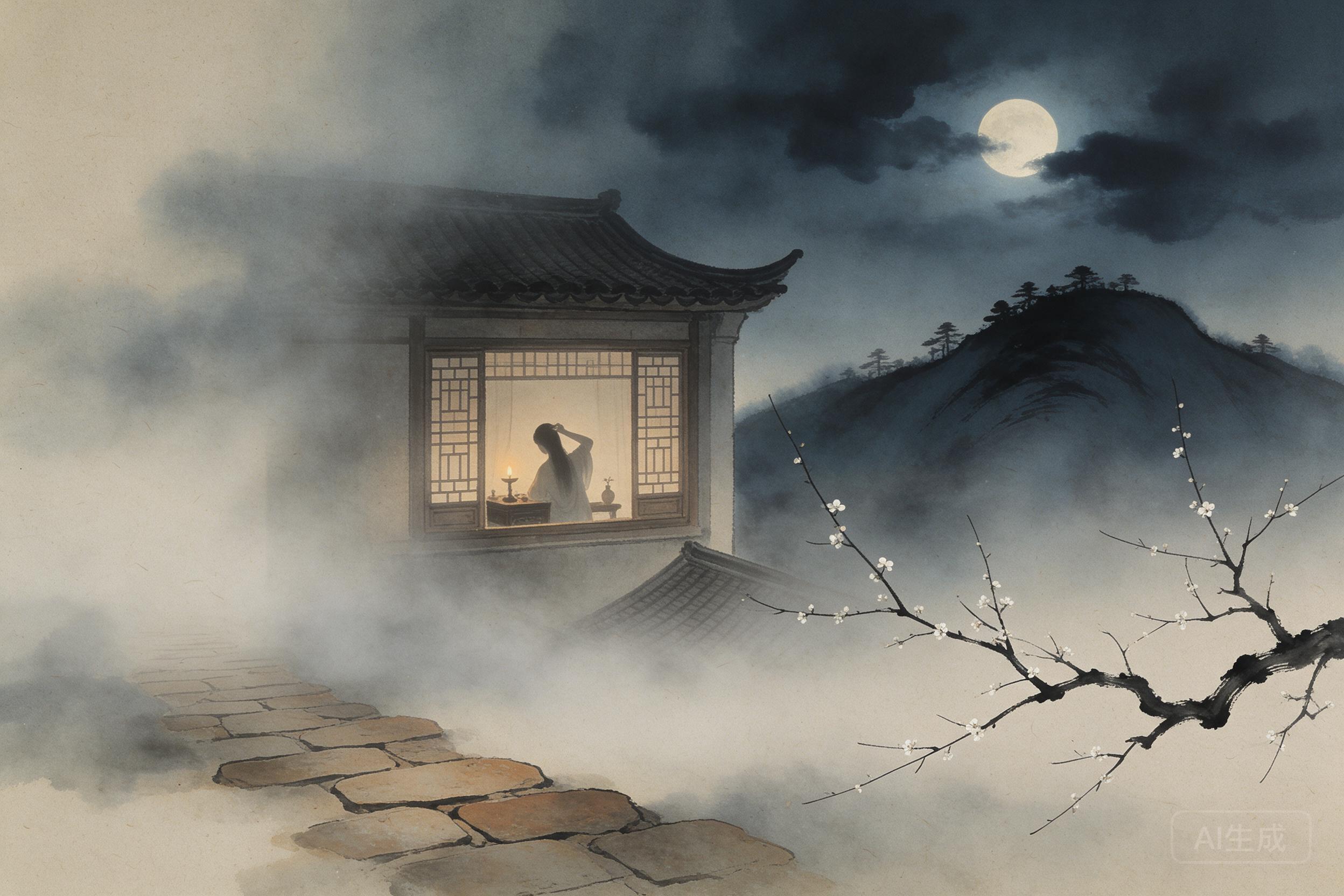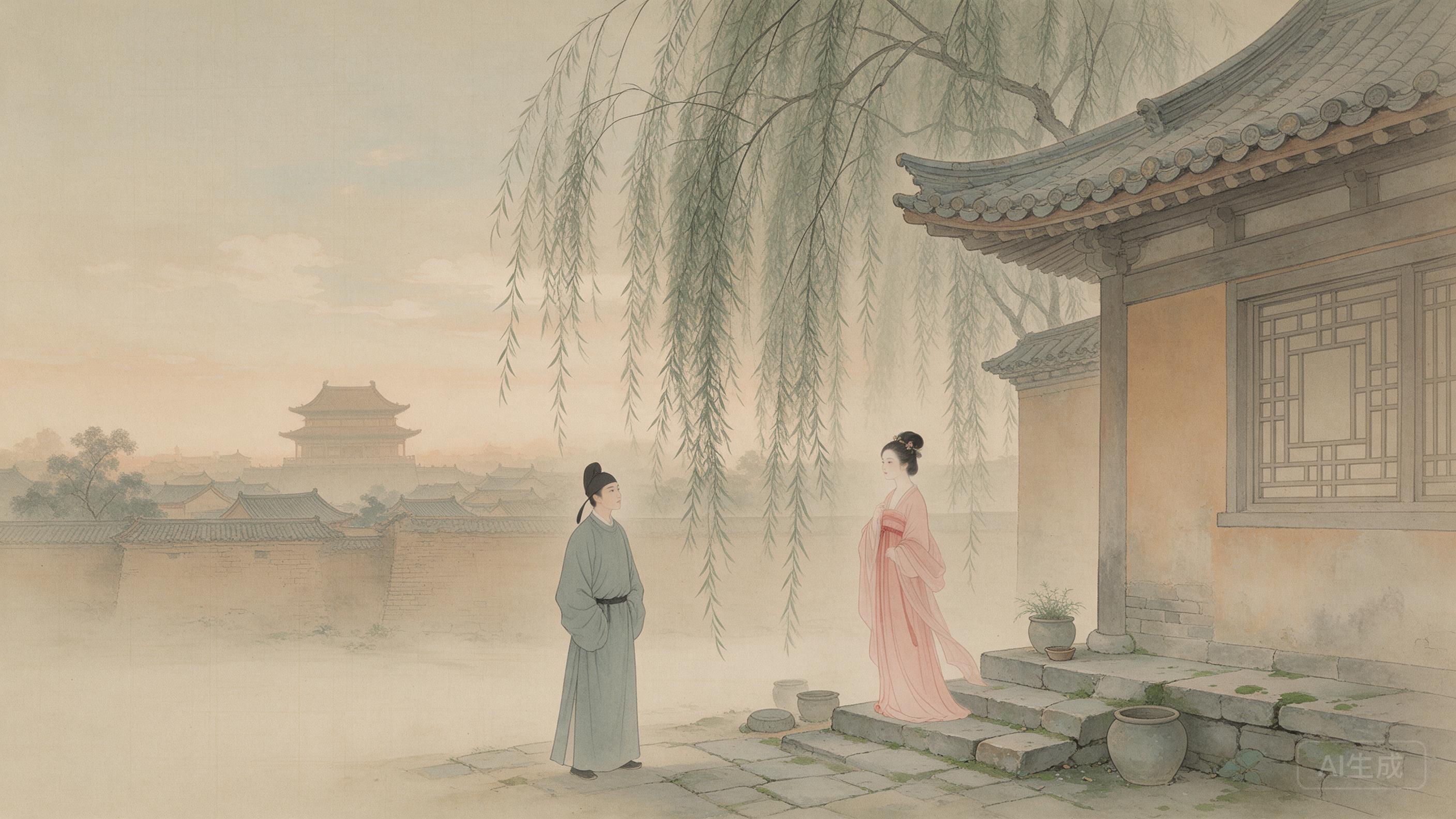
Once a year, Chinese tradition gives the two stars on either side of the Milky Way a single night together. Qin Guan wrote about that night in a short ci that almost everyone in Chinese can still quote, and he did something unusual with it: instead of mourning how brief the meeting is, he argues that brevity has nothing to do with value. This essay reads the poem line by line, explains the autumn images at its centre, and separates what the text says from what later legend has added.
The Chinese text quoted here follows the version of the ci printed in the Qing anthology Baixiang cipu jian, as transcribed on Wikisource, and agrees with the text given in standard modern accounts of Qin Guan's work. The tune is often headed simply "Queqiao xian" and sometimes "Queqiao xian: Qixi"; minor orthographic variants exist between anthologies (for example 暗度 / 暗渡 for the same word), but the wording discussed here is the common one. Attribution to Qin Guan is not in dispute in the tradition, and the poem is counted among his ci; the date of composition is not established, and the surviving chronologies differ. No source names the person for whom it was written. Southern Song anecdote (the story of a singing girl in Changsha) and later drama and fiction (the tale that Qin Guan married Su Shi's sister, Su Xiaomei) are treated in this essay as legend, not biography.
A Night in the Seventh Month
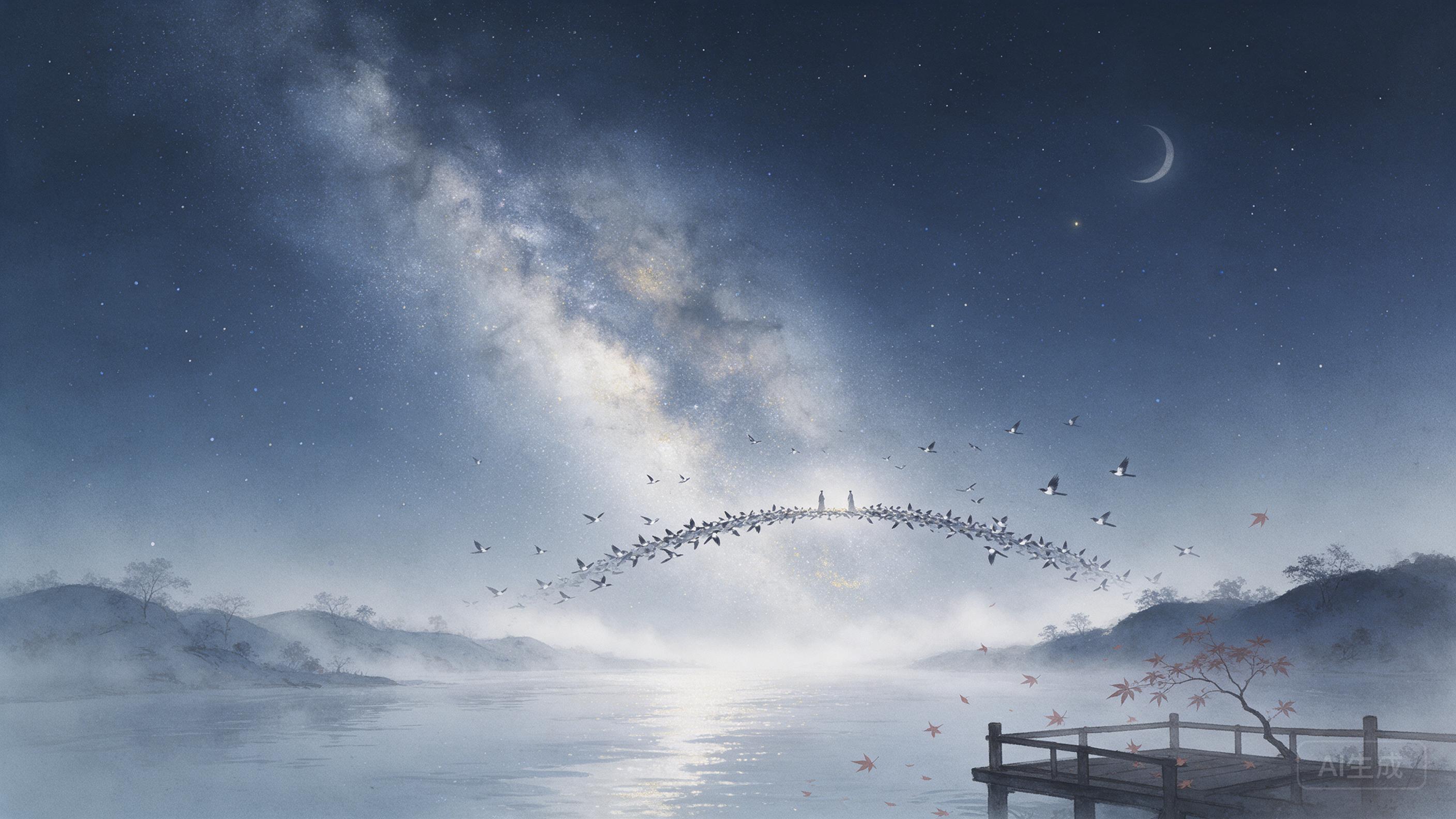
Chinese tradition gives the two brightest stars on either side of the Milky Way one night together a year. The Weaver Girl and the Cowherd, parted by the river of stars, meet on the seventh night of the seventh lunar month, when magpies join their wings into a bridge. The festival that grew around it, Qixi, was also a women's night of needlework, when girls asked the Weaver Girl for skill. Qin Guan wrote to the tune "Queqiao xian", "Immortals of the Magpie Bridge", taking that one night as his subject. Earlier poems on the theme mourn the short meeting; Qin Guan accepts it and turns the conclusion around.
The Words on the Page
The ci as it is normally printed runs:
Thin clouds practise their skill, flying stars carry regret, the River of Stars is crossed, far and dim, in secret. Golden wind and jade dew, one meeting, and it surpasses the countless meetings of the human world.
Tender feeling like water, the good hour like a dream, how can one bear to look back at the return road over the magpie bridge? If the two hearts are long, long enduring, what does it matter that they are not together morning and evening?
Golden Wind and Jade Dew
The opening is all motion and all distance. "Thin clouds practise their skill" is not only weather: qiao, craft, is the word in qiqiao, "begging for skill", the Qixi custom, so the clouds above do what the women below do. "Flying stars carry regret" gives the meteors a message: the regret arrives before any figure does. Then the crossing: far, dim, secret.
"Golden wind and jade dew" is the phrase readers remember. Golden wind is the autumn wind; jade dew is the white dew of early autumn that makes the night cold. Both are season words, both images of value. The meeting lasts one night, and the poem calls it better than the innumerable meetings of the human world. That verb, "surpasses", is the hinge. It does not deny the brevity; it says the brevity does not decide the worth.
"If Love Endures"
The second half moves from sky to feeling. "Tender feeling like water" keeps the water image and softens it. "The good hour like a dream" gives the night the quality of a dream, which in Chinese poetry can mean both beauty and unreliability. "How can one bear to look back at the return road": the point is not that the speaker looks back, but that looking back is unbearable. Then the closing couplet, which many Chinese still say at partings.
"Morning and evening" means daily, unbroken company. The couplet is usually read as consolation and redefinition: constancy is measured by the quality of the bond, not by the number of days spent together. Notice what it does not say. It does not say that separation is good, or that lovers should stop wanting each other's company. The longing for the return road is still in the poem; the argument is made against it, not instead of it.
The Poet Behind the Voice
Qin Guan (1049-1100), courtesy name Shaoyou, was from Gaoyou in Yangzhou, in modern Jiangsu. A protege of Su Shi, he is counted with Huang Tingjian, Chao Buzhi and Zhang Lei among the "Four Scholars of the Su School". He passed the examination late, served in the capital, and when Su Shi's opponents took power in the 1090s was demoted and exiled southward; he died in 1100 travelling back north. Later literary history treats him as a leading "delicate and restrained" (wanyue) poet; that is a later classification of style, not a school he founded. His poems are collected as Huaihai ji, his ci as Huaihai jushi changduanju.
What the Poem Cannot Tell Us
Nothing in the text names a recipient. The year of composition is not established; the surviving chronologies disagree, and no contemporary document ties the poem to a person or occasion. The speaker is a voice in a musical form and need not be the poet in his own situation. The Cowherd and the Weaver Girl are figures of myth, not disguises for the author's private life. That it was written for a singing girl met in Changsha, or for his concubine Bian Zhaohua, rests on Southern Song anecdote and later drama, not evidence. The story that he married Su Shi's witty sister Su Xiaomei is fiction; no such person is attested.
Reading It Without the Legends
Qin Guan's turn is clean. Qixi verse usually argues that a meeting once a year is pitiable; he argues that what is rare is worth more. Anyone who has counted days toward a reunion has made the move already, which is why the ending is still quoted at partings.
Sources & further reading
- Queqiao xian (Qin Guan), text of the ci as printed in Baixiang cipu jian (Wikisource, Chinese text)
- Song Shi (History of the Song), juan 444, biographies of Huang Tingjian, Chao Buzhi, Qin Guan and Zhang Lei (Wikisource, Chinese text)
- Qin Guan (Wikipedia in Chinese): courtesy names, hometown, the Four Scholars of the Su School, official career and exile, collected works
- Qixi Festival (Wikipedia in English): date in the seventh lunar month, the Cowherd and Weaver Girl, and the Qiqiao custom of praying for skill