Liu Lanzhi is a weaver of seventeen, married into the household of a minor official named Jiao Zhongqing. Her mother-in-law wants her gone; her husband, obedient and in love, can protect her only with a vow. The Han ballad that carries their story is built from dialogue, domestic detail and one of the most quoted promises in Chinese poetry — "be the rock, and let me be the reed" — and it ends not with rescue but with a pair of trees and two birds. This article follows the poem's scenes and its sources.
The poem is anonymous. Xu Ling's Yutai xinyong (sixth century) includes it among old poems as "an old poem, by an unknown hand, composed for Jiao Zhongqing's wife"; Guo Maoqian's Yuefu shiji (twelfth century) prints it as Jiao Zhongqing qi with the note that its author is unknown. Quotations follow the Yuefu shiji text as transcribed on Chinese Wikisource, with the poem's prose preface placing the events in the Jian'an era of the late Eastern Han. English versions of the quoted lines are the site's own translations, rendered line for line as closely as English word order allows. Readings of the ending are interpretation, not record.
A Pair of Birds That Will Not Fly Straight
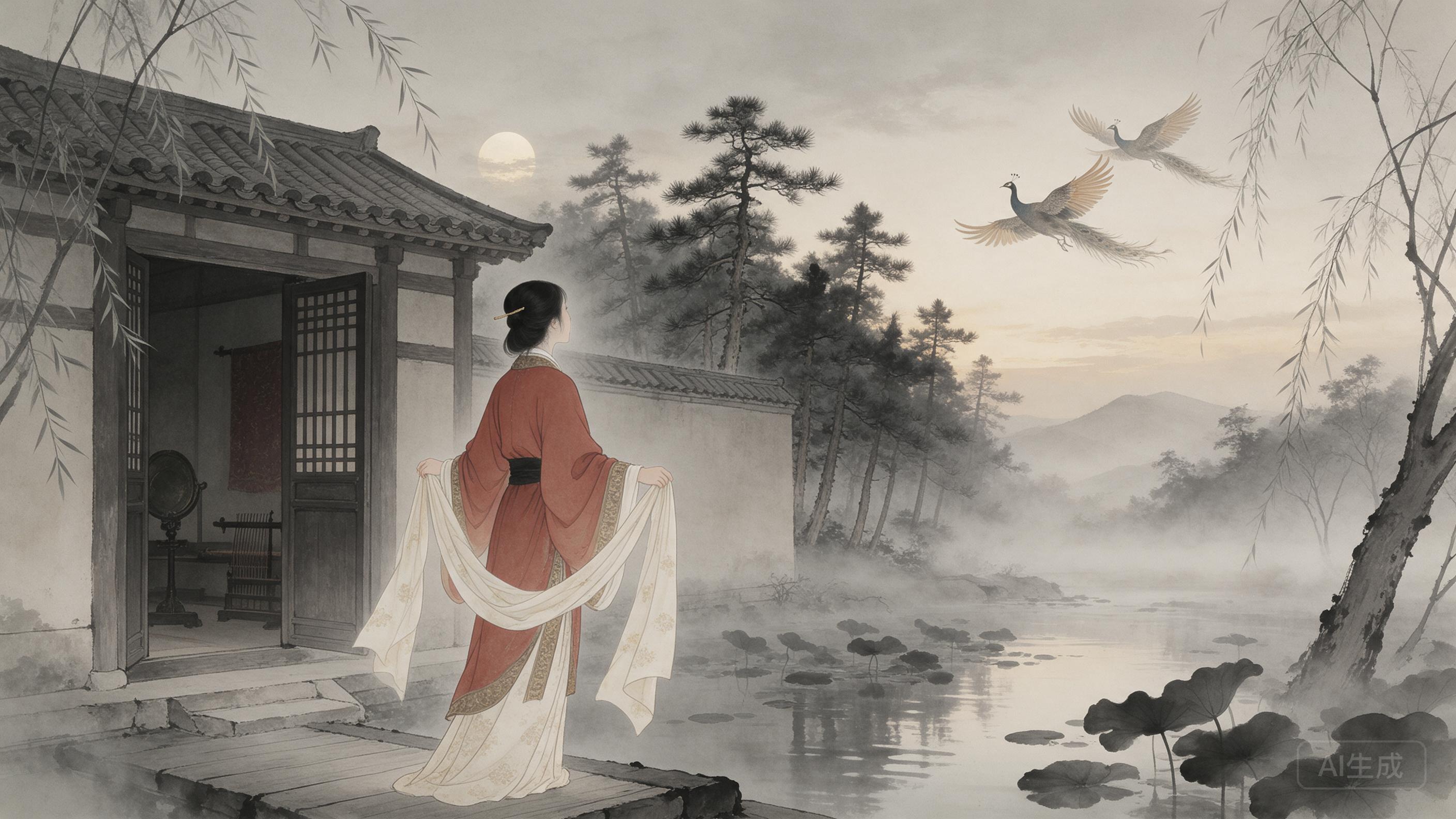
「孔雀東南飛,五里一徘徊」 — "The peacocks fly southeast; every five li they turn and circle back." Those are the poem's first two lines, and they also describe how it moves. Nothing in this story travels in a straight line: a wife is sent away and comes back only as a corpse, a husband promises to fetch her and instead follows her into the ground. The image of birds that rise and yet keep looking backward sets the tone for everything after it. Around that image the poem unfolds in more than three hundred five-character lines, built almost entirely from scenes and direct speech — a loom at night, a mother's anger, two carts halted on a road, a wedding, a pool, a tree — with a narrator stepping in only to close each scene and move us on.
The Wife Who Asked to Be Sent Home
Liu Lanzhi introduces herself by her skills: weaving at thirteen, cutting cloth at fourteen, the konghou at fifteen, the Odes and Documents at sixteen, married at seventeen. She works the loom from cockcrow and never rests; in three days she cuts five bolts of cloth, and still her mother-in-law calls her slow. Rather than wait to be expelled, she asks her husband to plead with his mother and send her home openly. Jiao Zhongqing does plead. He recalls that the two of them swore to be companions even beneath the Yellow Springs, and when his mother brushes this aside he tells her that if this wife is sent away he will never take another. His mother pounds the bed in fury and threatens him; he bows, says nothing, and obeys.
Rock and Reed: The Vow on the Road
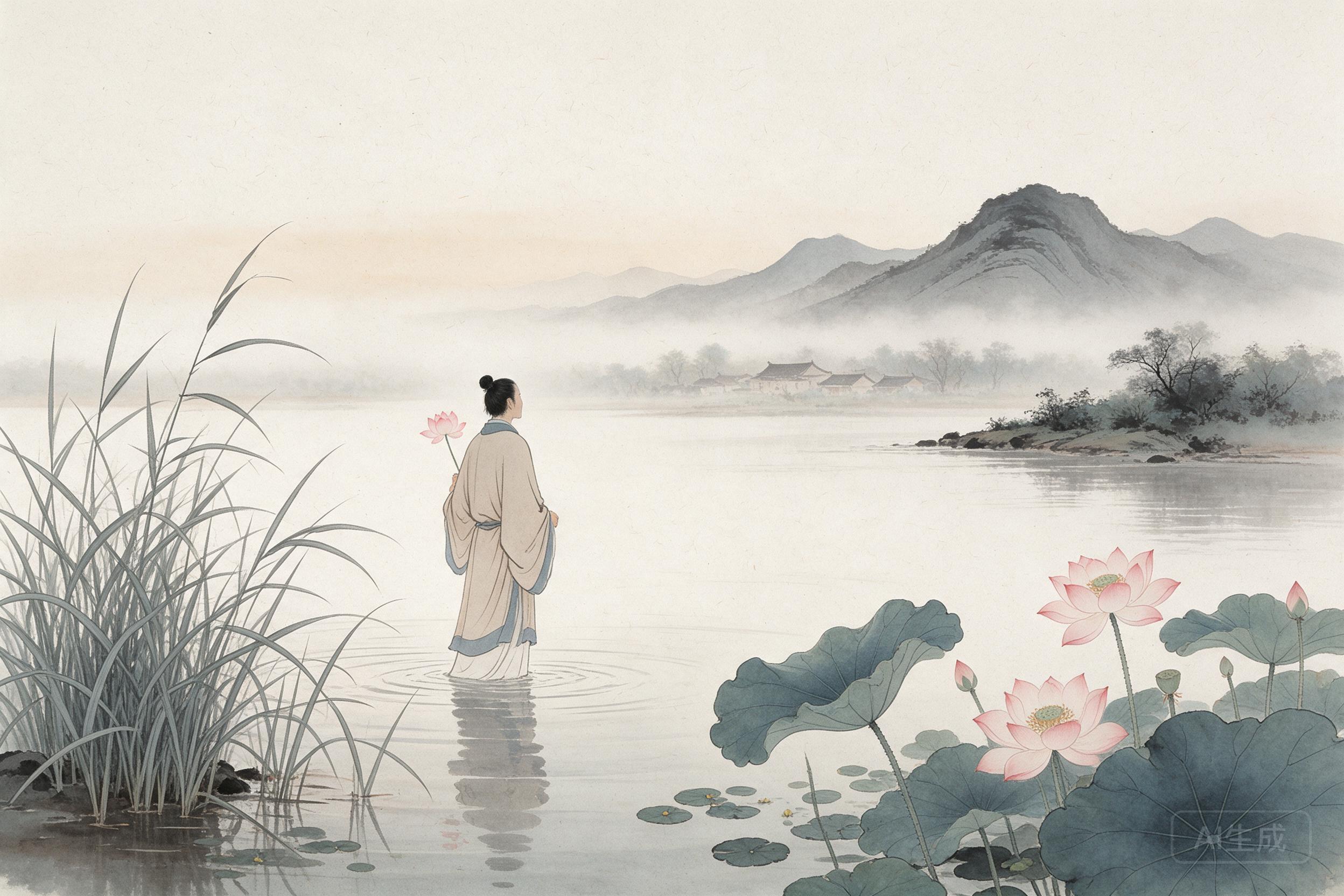
They part at the crossroads. Standing by the cart he whispers that he must go to his office, will return soon, and will never betray her. She answers with the poem's most quoted image:
> 君當作磐石,妾當作蒲葦。 > 蒲葦紉如絲,磐石無轉移。
"Be the rock," she says, "and let me be the reed. Its fibres twist as tough as silk; the rock will never shift."
The promise is beautiful and, in the event, unbearable. She has named herself the weaker thing, and the poem holds her to the name: the reed is what breaks. Read this way the quatrain is less a comfort than a forecast, and the tenderness of the scene comes from the fact that neither of them can see it.
The Pool and the Southeast Branch
Back in her family home, a violent-tempered elder brother presses her into a match with the commandery governor's son, and she gives way. Jiao rides over to reproach her: the rock, he says, is thick and may last a thousand years, while the reed, twisted in a moment, lasts a single night. She does not argue. She tells him that they will meet below the Yellow Springs. On the wedding day she 「舉身赴清池」, throwing herself into the clear pool. He hears of it, lingers under the courtyard tree, and hangs himself from a southeast branch.
Two Trees, One Canopy
The two families ask for a joint burial and lay the pair together beside Mount Hua. Pines and cypresses are planted east and west, wutong trees to left and right:
> 枝枝相覆蓋,葉葉相交通。 > 中有雙飛鳥,自名為鴛鴦。
Branch covers branch and leaf crosses leaf; in the middle are two birds that call themselves mandarin ducks, singing to each other until the fifth watch, so that travellers stop to listen and widows rise and wander. The ending is usually read as consolation, and it is worth being exact about what kind: the trees do not reward the couple or overturn the verdict against them. They are what the poem can offer instead of justice — a shape in which two ruined lives at least hold together.
A Poem Without an Author
The text survives in two old anthologies. Xu Ling's sixth-century Yutai xinyong prints it among anonymous old poems, as "an old poem, by an unknown hand, composed for Jiao Zhongqing's wife"; Guo Maoqian's twelfth-century Yuefu shiji titles it Jiao Zhongqing qi, classes it with the "miscellaneous songs", and prefaces it: of Jiao Zhongqing's wife, we do not know whose work it is. That preface also supplies the setting — during the Jian'an era, at the close of the Eastern Han, in the household of a petty clerk of Lujiang commandery. It is a literary frame, not independent evidence, and belongs to the poem's transmission rather than to a chronicle. What the sources do establish is form and standing: a long narrative in five-character lines, the earliest of its kind preserved in Chinese, regularly paired with the Ballad of Mulan as the two masterpieces of yuefu.
Sources & further reading
Editorial approach