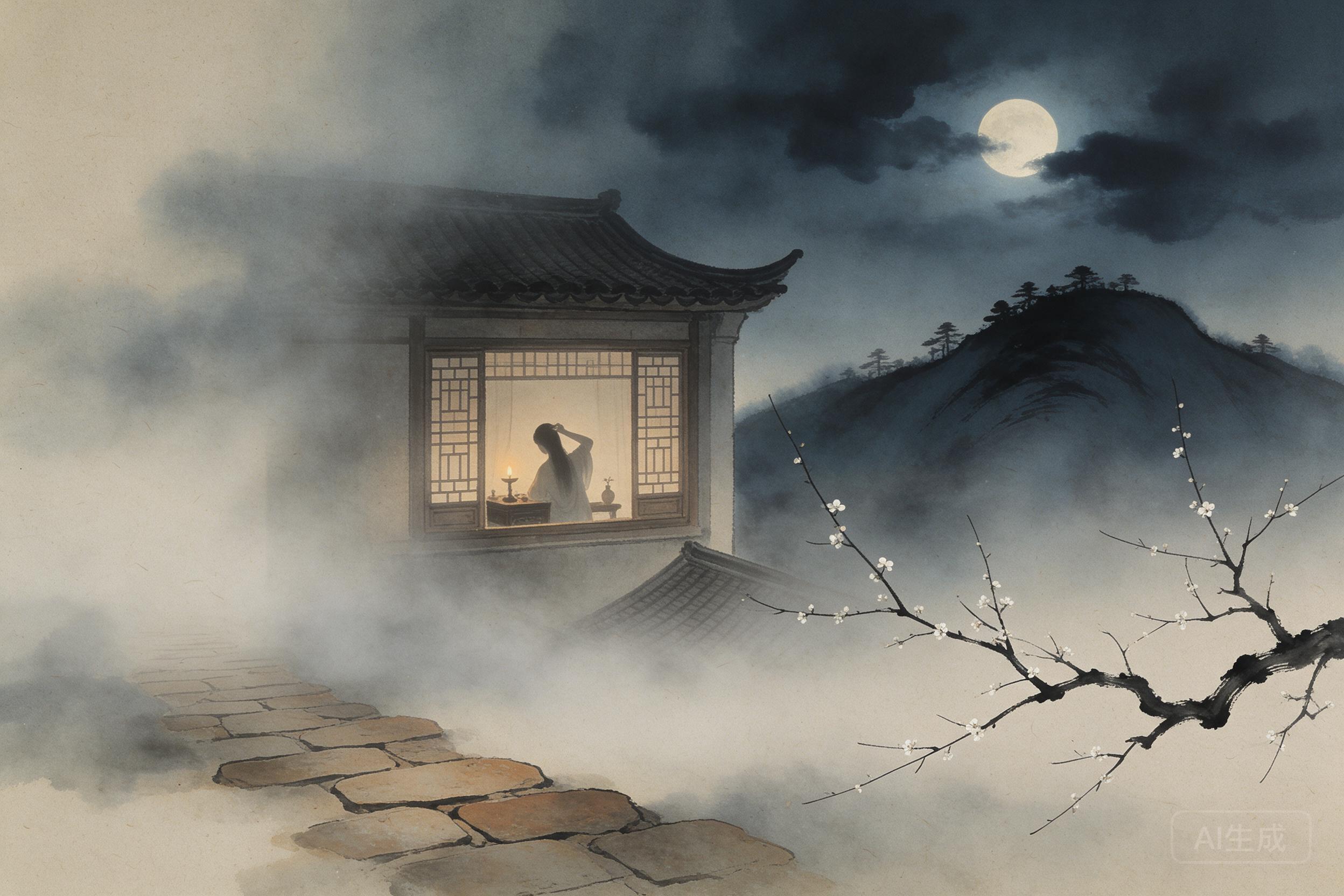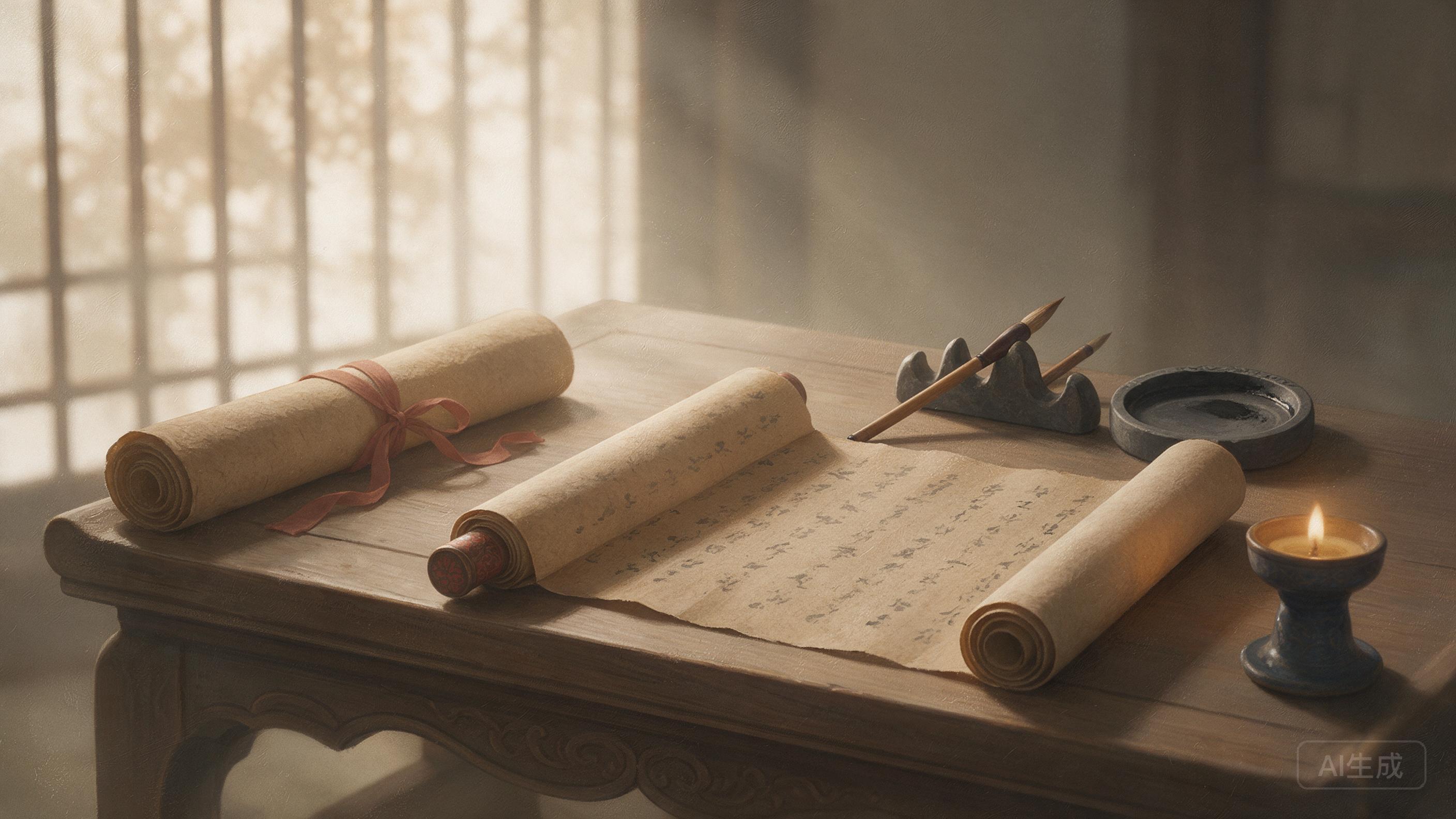
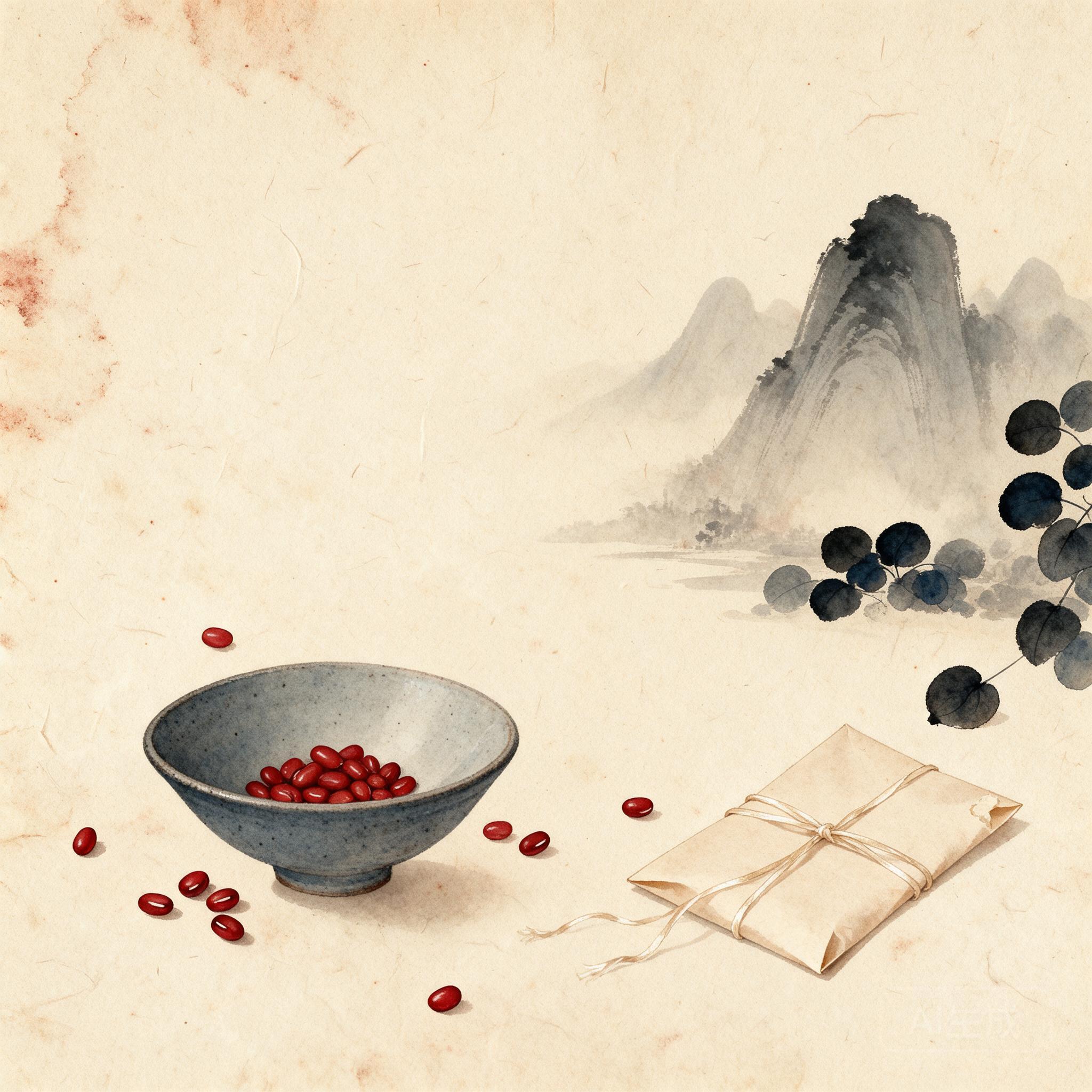
A short poem that later centuries turned into a love token. Read closely, it says less about romance than about how an object can be made to carry a feeling — and it says it in twenty characters.
This essay keeps three layers apart: what the surviving text and Wang Wei's biography attest; the long-standing conventional reading of the red bean as a token of longing; and material that is later or uncertain, including the alternative title "Presented to Li Guinian" and the botanical identification of the bean. The quatrain survives in several variants, none of them authoritative, and its date of composition is unknown. No contemporary source connects it to a romantic attachment. English renderings of the poem are the writer's own.
Twenty Characters
Red beans grow in the south; when spring comes, how many branches open? I hope you will gather many of them: this thing most calls up longing.
That is Wang Wei's "Mutual Longing" (Xiang si), as printed in the Complete Tang Poems, juan 128: four lines of five characters, and almost no machinery — no journey, no parting scene, no weather, no name. A translator must supply what an English reader expects from a love poem.
A Text That Was Never Quite Fixed
Its variants are unusually visible, and the standard transcription keeps them in small notes: chun lai or qiu lai, "when spring comes" or "when autumn comes"; fa ji zhi or fa gu zhi, "how many branches" or "the old branches"; yuan jun or zeng jun, "I hope you" or "I give you"; duo cai xie or xiu cai xie, "gather many" or "do not gather." Some anthologies print quan jun duo cai xie, "I urge you to gather many." These are not scribal noise. The season changes the poem's temperature; invitation or prohibition changes what kind of gift the bean is. No autograph survives; no edition can claim the original.
From Plant to Claim
The poem moves in four steps and never repeats itself: a plant and a place; a season and a number that cannot be counted; an action asked of someone; a verdict. The last line is the one that lasts. The speaker does not say "I miss you" or "you will remember me." He points at an object — ci wu, "this thing" — and hands it the work of feeling. A simile compares; this line does something cooler, appointing a bean to the office of memory. That is why it can be given to almost anyone travelling south, and why it never says what the two people are to each other.
Whose Longing?
The title is xiang si, and xiang means "mutually," "toward one another": the compound names a longing that runs both ways. In Tang usage it was not reserved for lovers. Friends far apart, brothers in different provinces, an official kept from the capital could all be said to xiang si. The poem names the emotion and never names the relation.
Wang Wei's life supplies no answer a reader should trust. Born around 700 into a branch of the Taiyuan Wang clan, he passed the examinations, served at court, was briefly exiled, and rose to senior secretary of the right — hence Wang Youcheng. He was in Chang'an when An Lushan took it, was pressed into the rebel administration, pardoned after the restoration, and died in 761. A painter and a serious Buddhist, he did not remarry after his wife's death, later biography says. None of this identifies an addressee, and no contemporary document ties the poem to a love affair.
The Later Title
Later editions and anecdotal records give the poem a second title, Jiang shang zeng Li Guinian, "On the River, Presented to Li Guinian." Li Guinian was among the most celebrated musicians of Xuanzong's court, a singer trained in the Pear Garden, remembered in Du Fu's lines about the mansions of Prince Qi and Cui Di; the rebellion ended that world, and by one later account he drifted south and died at Xiangtan.
If the second title rests on anything real, the poem was a parting gift to a musician friend, which strengthens rather than weakens the argument here. But the title is not in the poem, is not Wang Wei describing his own occasion, and cannot be dated; it belongs to the history of how the poem was sung and read.
Which Bean?
Hong dou is a name, not a species. Chinese usage has gathered several plants under it: Abrus precatorius, a twining vine whose hard scarlet seeds carry a black spot and a toxic protein, ornamental rather than edible; trees of the genera Adenanthera and Ormosia, whose red seeds are drilled for beads; and the ordinary kitchen bean, Vigna angularis, which is food and has nothing to do with the poem's south. Which one a Tang poet meant, or whether he meant a general impression of southern red seeds, cannot be settled.
How It Became a Love Poem
None of this makes the love reading wrong, but that reading belongs to the poem's later reception. "Mutual Longing" was included in the Three Hundred Tang Poems, the schoolroom anthology compiled in the eighteenth century, and has long been recited and sung; the red bean became a token of romantic love, and the poem is often read backward from that token. That reception is real, but it is not evidence that Wang Wei wrote about a woman. The poem's restraint — a plant, a season, an errand, a claim — is precisely what let generations pour their own attachments into it.
Sources & further reading
- 相思(王維),維基文庫:錄《全唐詩》卷128本文並附異文校記
- 全唐詩 卷一百二十八(王維),維基文庫
- 唐詩三百首,維基百科(清乾隆間孫洙編成,收王維詩二十九首)
- 王維,維基百科(生平、科第、尚書右丞、安史之亂、卒年)
- 李龜年,維基百科(梨園樂工、安史亂後流落、大曆間卒於湘潭;並及《江上贈李龜年》題名)
- 紅豆(消歧義),維基百科(紅豆一名所指之數種植物)
- Abrus precatorius, Wikipedia(相思子種子性狀與毒性)