It is one of the most concentrated poems of longing in Chinese, and only eight lines long: forty characters, no named author. A traveler picks lotus flowers in a river, holds a gift he cannot send, looks back toward home, and understands that the distance will not close. Below are the original text, a new English translation made for this site, and a reading of the line the whole poem turns on: hearts together, lives apart.
The poem is anonymous. It is preserved as the sixth of the Nineteen Old Poems in Wen xuan (Selections of Refined Literature), compiled in the sixth century; an old tradition sometimes names Mei Sheng, but the Wen xuan commentary already calls that attribution uncertain, so this article treats the author as unknown. The Chinese text follows the Wikisource transcriptions of the single poem and of the Nineteen Old Poems collection, in the common simplified form, eight lines. The English translation and the interpretation are original to this site: the translation is not part of the original poem, and the interpretation is not historical record.
A Flower Gathered in Midstream
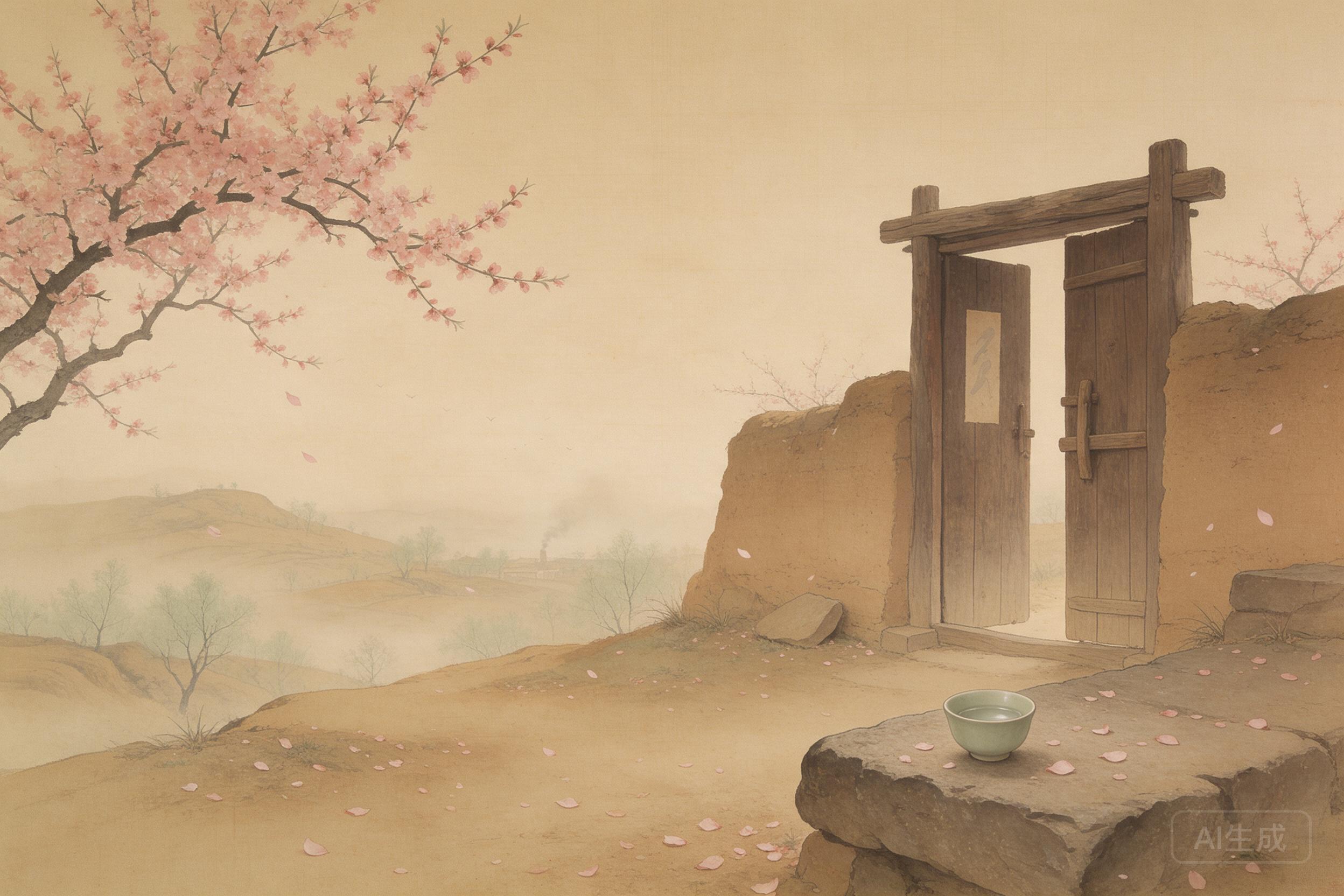
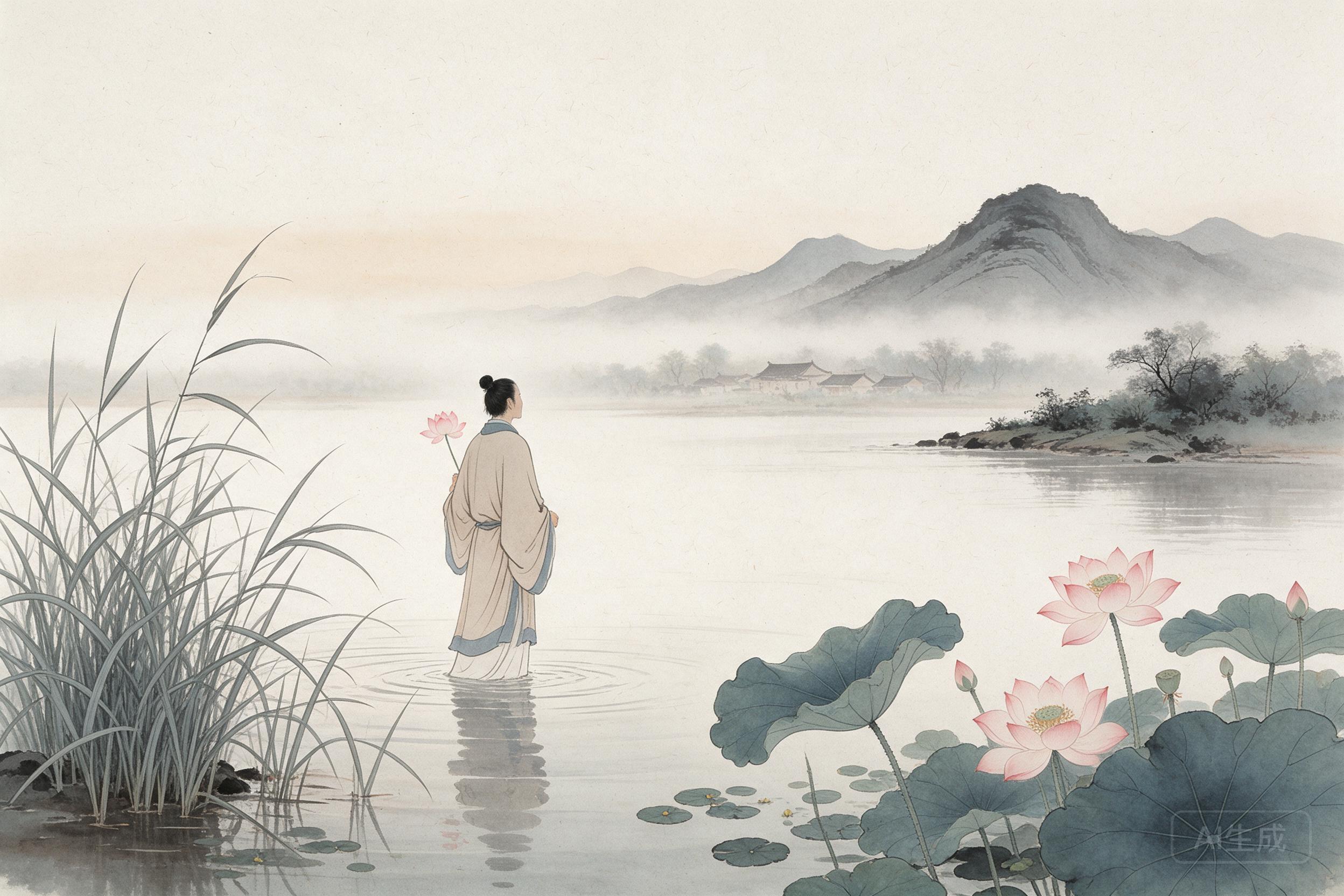
The poem opens with a small, deliberate action. Someone wades across a river to pick lotus flowers — furong, the water lotus, not the woody hibiscus that carries the same name in Chinese — and the low, wet meadows around the water are thick with fragrant grasses. It is a scene of abundance: the flowers are within reach, the scent is on every side. Then comes the turn that gives the poem its weight. The flowers have been gathered, but a flower has to be given to somebody, and the person the speaker has in mind is far away.
The text is short enough to hold in the hand:
涉江采芙蓉,兰泽多芳草。 采之欲遗谁?所思在远道。 还顾望旧乡,长路漫浩浩。 同心而离居,忧伤以终老。
Eight lines of five characters each, forty characters in all, rhyming on the even lines. It belongs to the Nineteen Old Poems, a group of Han-dynasty pieces preserved in the sixth-century anthology Wen xuan. The author is unknown. An old tradition sometimes names Mei Sheng, but the Wen xuan commentary already calls that attribution uncertain; it is best left as a tradition, not a fact.
The Poem in English
What follows is this site's own English translation — a modern rendering, not a historical document, to be read beside the original rather than in place of it.
Wading the river, I gather lotus flowers; the orchid marshes are full of fragrant grass. I pick them—but who is there to receive them? The one I think of is on a distant road. Turning my head, I look back toward my old home; the long way stretches, vast and endless. One heart with you, and yet we live apart— sorrow, until the end of my days.
The eight lines move in one unbroken arc: the gathering, the question of who will receive the gift, the person placed far off, the turn toward home, the road that refuses to close, the plain statement of what this means, and the quiet forecast of grief for a lifetime. Nothing is explained; the poem walks the reader through a sequence of gestures, and the feeling gathers from them.
One Heart, Two Places
Everything in the poem rests on one line: hearts in accord, and lives apart. The sorrow is not that love has failed; it is that love is intact and unusable. The lotus was picked in the belief that it could be carried to someone, and the journey that would make the gift meaningful is exactly the journey that cannot be finished. Turning the head toward home is not a decision to go back; it is the gesture of someone who knows the distance will not close. "Vast and endless" is not a measurement but a verdict.
Readers have sometimes heard a woman's voice here; the poem does not require it. Zhu Ziqing, reading this piece beside another of the nineteen, noted the layer of a traveler looking back toward his old country, and this article follows that reading: the speaker is out on the road. Gender is never stated; only distance is. The word translated "to give" is wei — to present something to someone — not yi, to leave behind. A flower left behind is merely lost; a flower meant as a gift holds a whole relationship in the hand, and it is the failure to deliver it that the last line measures. Grief here is not an event but a duration.
Why a Nameless Poem Still Speaks
The poem's power lies partly in how little it says. The diction is plain, the scene ordinary, the syntax almost conversational, and there is no allusion to display. Yet the plainness is exact: a flower, a marsh, a road, a backward glance. What the poem leaves out — who the other person is, how the two were separated, whether they will ever meet — is not a gap in the writing but the space in which a reader's own life can enter.
Later readers have enjoyed a play on sound that the poem never states. Furong, lotus, sounds close to furong, "a husband's face," and lian, lotus, is a homophone of lian, to cherish. These are charming later associations, not the poem's argument — the text asks only that a flower be given — but they show how readily the lotus lent itself to lovers.
Then there is the anonymity. No biography attaches to these lines, no career, no scandal, no known face. A named poet's grief belongs to that poet; an unnamed poet's grief can belong to anyone who has stood on a bank with something in hand and no way to send it. That is why the poem has outlived its dynasty: the flower is still being held, and the road is still long.
Sources & further reading
Editorial approach