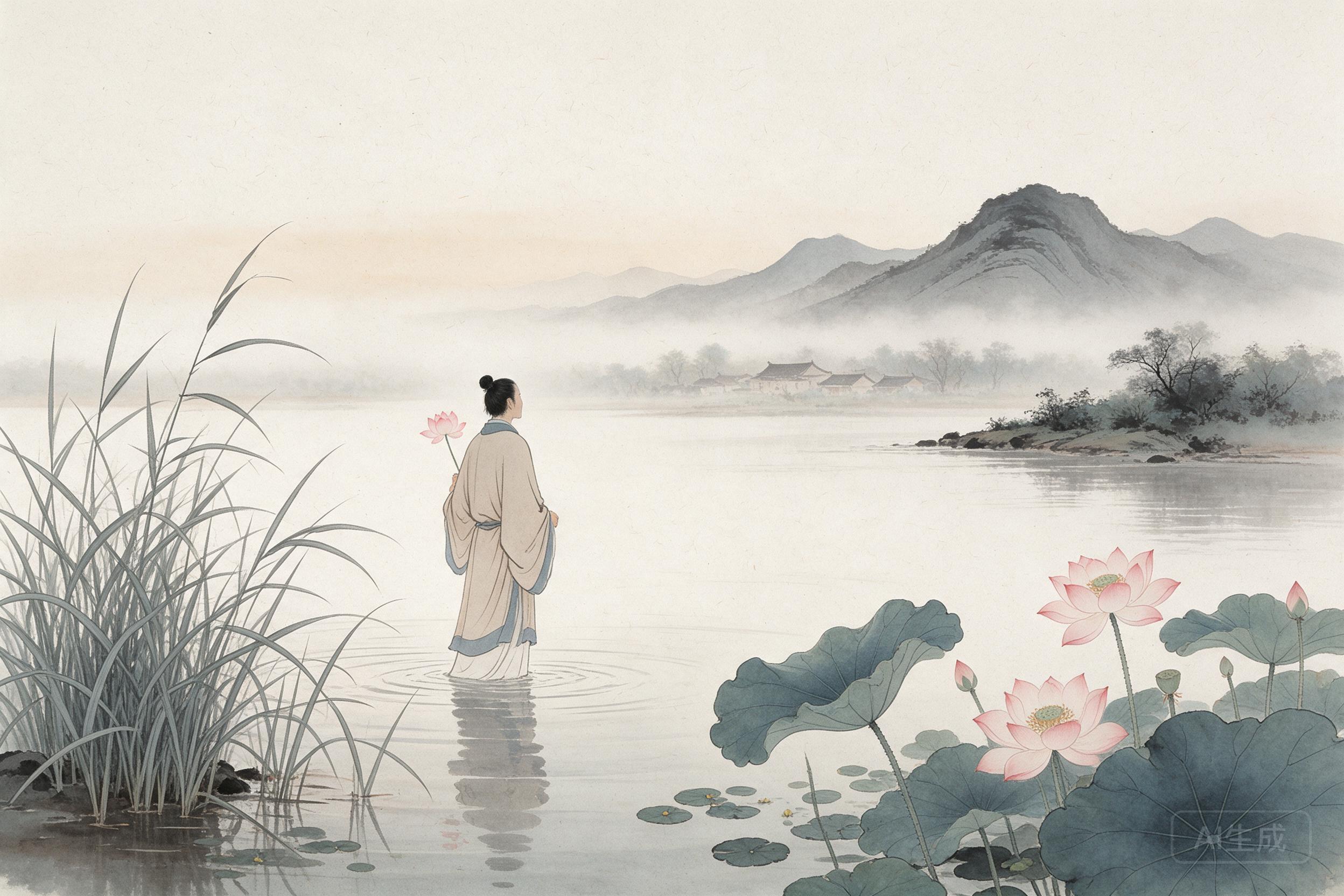
The poem is twenty-eight characters long and describes almost nothing: the same gate, the same peach blossoms, and a face that is no longer there. It never says who the woman was, or what became of her. The story most readers know — the cup of water, the locked door, the poem written on the left leaf, the death and the revival — comes from a later prose source, Meng Qi's Benshi shi, prefaced in 886. This essay keeps the poem, the Tang notebook and a modern reading in separate rooms, and looks at what each one can and cannot say.
Three layers are kept apart here. The poem is Cui Hu's “Inscription at the South Village,” printed in the Qing compilation Quan Tang shi, vol. 368 (https://zh.wikisource.org/wiki/全唐詩/卷368); its main text reads 人面不知何處去, with the collation note 一作祗今. The narrative of the cup of water, the locked gate, the writing on the left door, the girl's death and her revival comes from Meng Qi's Benshi shi, section “Emotional Attachment,” a ninth-century collection of anecdotes about poems whose preface is dated 886 (https://zh.wikisource.org/wiki/本事詩). Benshi shi prints the third line as 人面如今何處去; the difference between 如今 and 不知 is a textual variant, not a second story. The notebook is a literary anecdote about how a poem came to be written, not a historical record. Cui Hu's courtesy name, examination year and final office survive only in the Qing editorial biography in Quan Tang shi and are not used in this article; his native place, Boling, is already given in the opening words of Benshi shi itself. The note after the poem in Quan Tang shi also cites the Taiping guangji for a shorter telling of the same anecdote; that volume was not consulted for this piece.
The Gate, the Peach Blossoms, and One Year
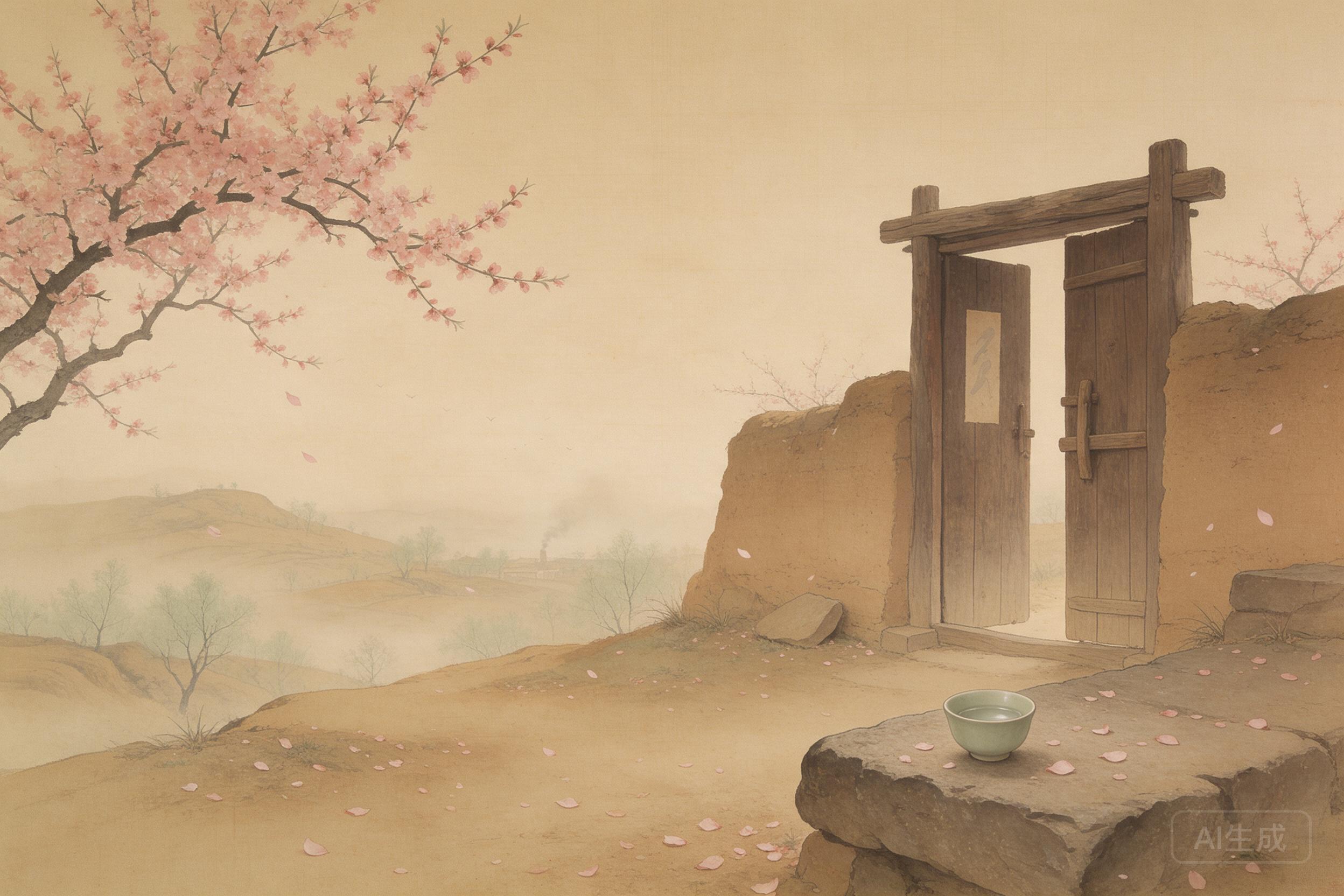
Four lines, and the first thing they establish is a date. “Last year on this day, inside this gate,” the poem begins, “a face and peach blossoms reddened each other.” No gate, road or household is named: the poem gives a door, a flowering tree, and a day of the year.
Then it returns to the same place. “The face, one does not know where it has gone; the peach blossoms still laugh in the spring wind.” Two spring days stand side by side, alike in blossom, different in one respect. That is the whole architecture: a scene repeated, a person subtracted.
Twenty-Eight Characters, and the Silence Around Them
In Chinese it is twenty-eight characters. Four are 人面, “a human face,” and four are 桃花, “peach blossom”; the repetition is the argument. The only verb that sounds like feeling belongs to the tree: the blossoms 笑, “laugh,” in the wind.
What the poem does not say matters as much. The woman is not named, not called young or beautiful, ill, married, or dead. There is no meeting, no conversation, no knock, no search. The speaker does not claim to have looked for her; he reports a gate and a season, and stops at “one does not know.”
The Story the Tang Notebook Adds
The rest comes from a later hand: Meng Qi's Benshi shi, a ninth-century collection of anecdotes about poems, prefaced in 886 and opening with a section on love. There the four lines acquire a plot. Cui Hu, a failed examination candidate from Boling, walks alone south of the capital at Qingming to a quiet residence of one mu, thick with flowers and trees. He knocks a long time. A girl peeps through the gap and asks who he is; he gives his name and asks for a drink. She brings a cup of water, opens the door, sets out a seat, and stands leaning against a slanting branch of a small peach tree.
The notebook adds that her regard seemed warm, and that when Cui Hu tried to draw her out she did not answer, only looked at him a long while. She saw him to the door and went in as if she could not master her feelings. Afterwards he did not come again.
The Poem on the Left Door, and the Return
A year later, on the same festival, he thought of her, could not restrain himself, and went back. The gate and wall were as before, but the door was locked. He wrote the poem on the left leaf of the door.
Days afterwards he returned and heard crying inside. An old man came out, asked whether he was Cui Hu, and said: “You have killed my daughter.” The girl had just reached the age of the hairpin and knew letters; she was unmarried, and since the previous year had often seemed distracted, as though she had lost something. She read the writing on the left door, went in, fell ill, and refused food until she died. Cui Hu entered and wept, lifted her head, rested it on his thigh, and said: “I am here, I am here.” She opened her eyes; after half a day she revived. The father rejoiced and gave her to him.
One Word Between the Versions
The two sources differ at one point. Benshi shi gives the third line as 人面如今何處去, “the face, where has it gone now?” The Qing-compiled Quan Tang shi prints 人面不知何處去, “the face, one does not know where it has gone,” and notes 祗今 — 只今, “only now,” the same sense as 如今, opposite 不知. 如今 makes the line a moment in time; 不知 leaves it in the dark. The received poem keeps a speaker who has learned nothing.
The Echo of the Peach Blossoms
Everything after the fourth line belongs to the notebook. 人面桃花 has since become a Chinese idiom for coming back to a familiar place and finding the person gone; that usage is later sediment, not Tang phrasing. The notebook answers every question the poem leaves open, who she was, what she felt, whether she lived, and turns a lyric of not-knowing into a story ending in a marriage.
This is a reading, not a record. Side by side, the texts disagree productively: the anecdote supplies the reunion the poem withholds, while the four lines keep their authority by refusing to say what happened next. The blossoms laugh, the gate is the same, and the sentence stops.
Sources & further reading
Editorial approach