In 589 the Sui armies took the Chen capital. Before the end, a court officer and the emperor's sister broke a mirror and each kept half. What followed in the capital's market survives in one late-Tang book — and in four characters of Chinese.
Source: Meng Qi 孟棨, Benshi shi 本事诗, chapter 1, “Qinggan” 情感第一 (late 9th century); the text quoted is the Siku quanshu edition on Chinese Wikisource, given in the sources list, where the Siku editors' preface notes that only two of the book's entries concern the Six Dynasties. All translations from classical Chinese are the author's own. Background on the Sui conquest of 589, the last Chen ruler, and Yang Su's title Duke of Yue (越国公) is from the encyclopaedia entries listed. Later embellishments — the mirror's whereabouts, the couple's life after Jiangnan, drama and film adaptations — are not used; the article says so where it matters.
A Promise Made in a Dying Dynasty
The story reaches us through one place: chapter one of Meng Qi's *Benshi shi* (“Poems and the Stories Behind Them”), late ninth century. Its Qing editors noted that only two of its anecdotes concern the Six Dynasties, and this is one.
Meng Qi opens flatly. “徐德言之妻,后主叔宝之妹,封乐昌公主”: Xu Deyan, an officer on the staff of the Chen crown prince, had as his wife the younger sister of the last Chen ruler, Chen Shubao, enfeoffed as Princess of Lechang. “才色冠绝”: her talent and beauty had no equal. “时陈政方乱”: Chen's government was in disorder. “德言知不相保”: Deyan knew the two could not be kept safe.
So he said it plainly. “以君之才容,国亡必入权豪之家,斯永绝矣” — with your talent and face, when the state falls you will surely enter some powerful man's house, and that is the end of us. “傥情缘未断,犹冀相见,宜有以信之” — but if our bond is not yet cut and we may still hope to meet, we should have something to vouch for it.
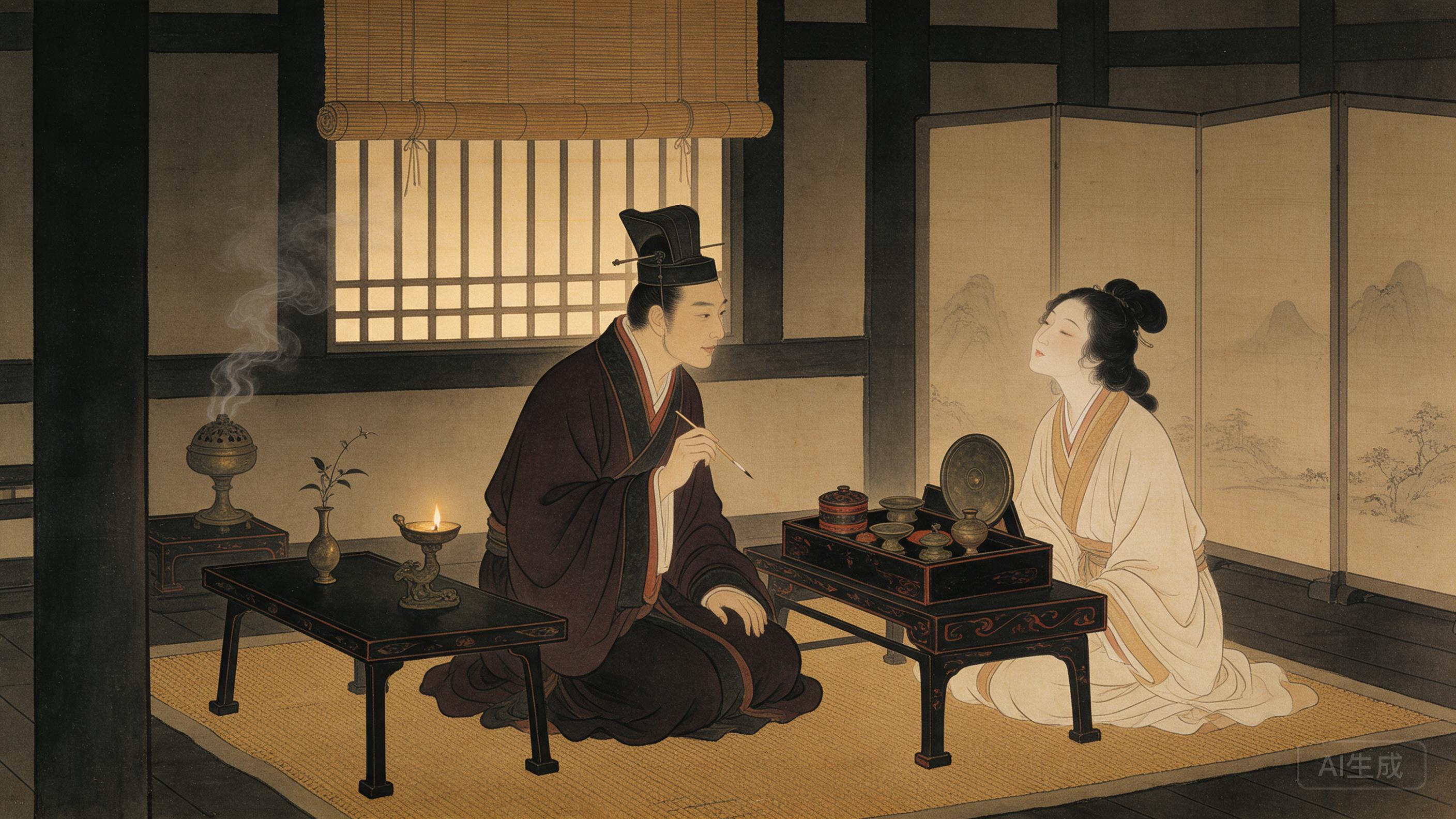
He broke a bronze mirror and gave her half. The terms were exact: on the fifteenth of the first month, the year's first full moon, sell your half in the market; I will be there, and on that day I will come looking.
A bronze mirror is cast, not cut: two halves of one casting meet only along their own irregular seam. The token cannot be forged, which is why the story never explains how they recognised each other's piece.
Half a Mirror in the Market
Chen fell in 589 to the Sui armies. His wife did enter the household of Yang Su, Duke of Yue — a commander in the conquest, later the most powerful man at the Sui court. “宠嬖殊厚”: her favour was very great. Deyan, “流离辛苦,” wandered and suffered and barely reached the capital.
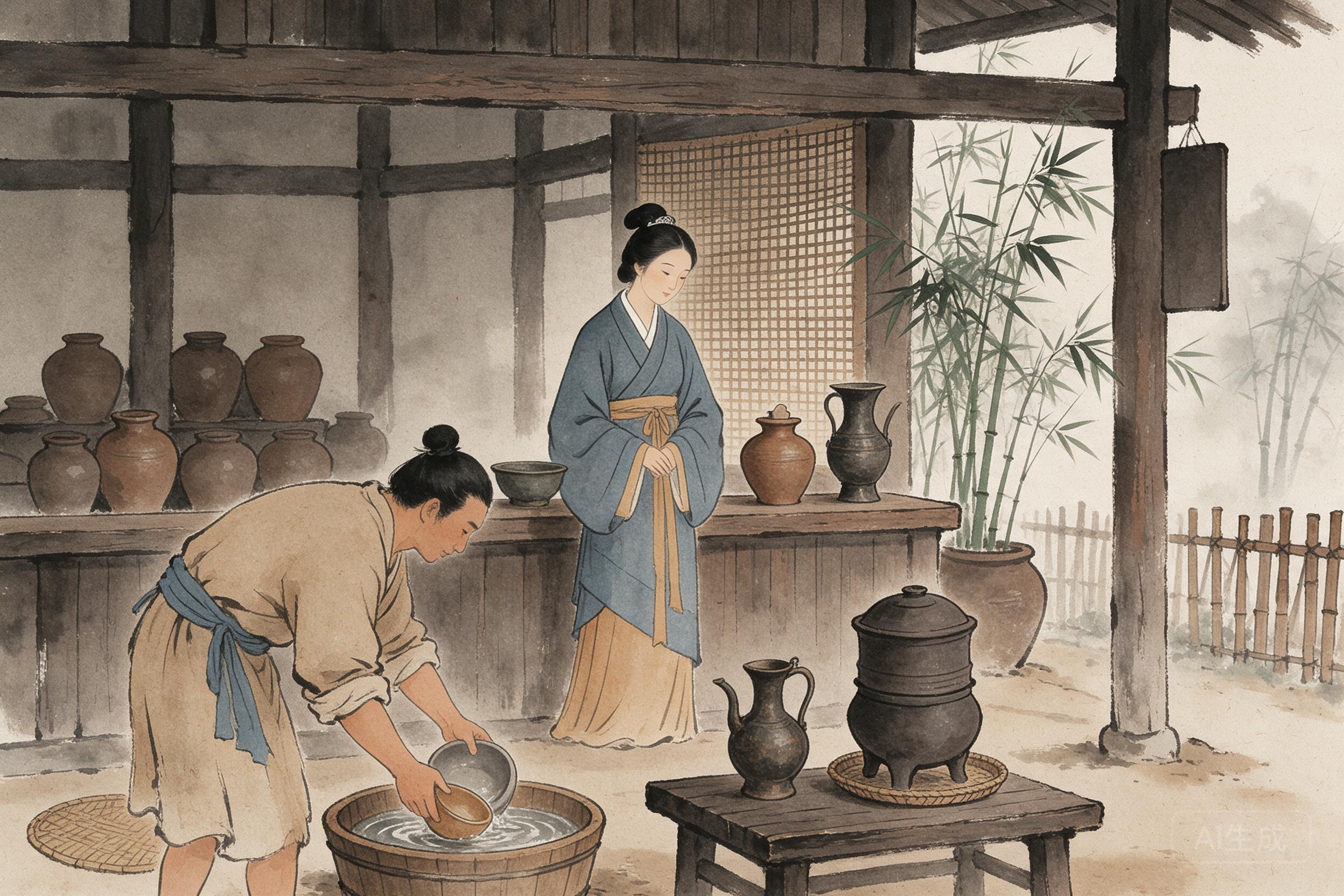
Then, on the day: “有苍头卖半镜者,大高其价,人皆笑之” — a servant was selling half a mirror at an absurd price, and everyone laughed at him. This is the hinge: only one person in the city could want such a thing, and the ludicrous price is how a woman who could not send a letter made half a mirror announce itself.
Deyan took the servant to his lodging, set out food, told him the whole story, and brought out his own half. They matched.
“The Mirror Has Come, the Person Has Not”
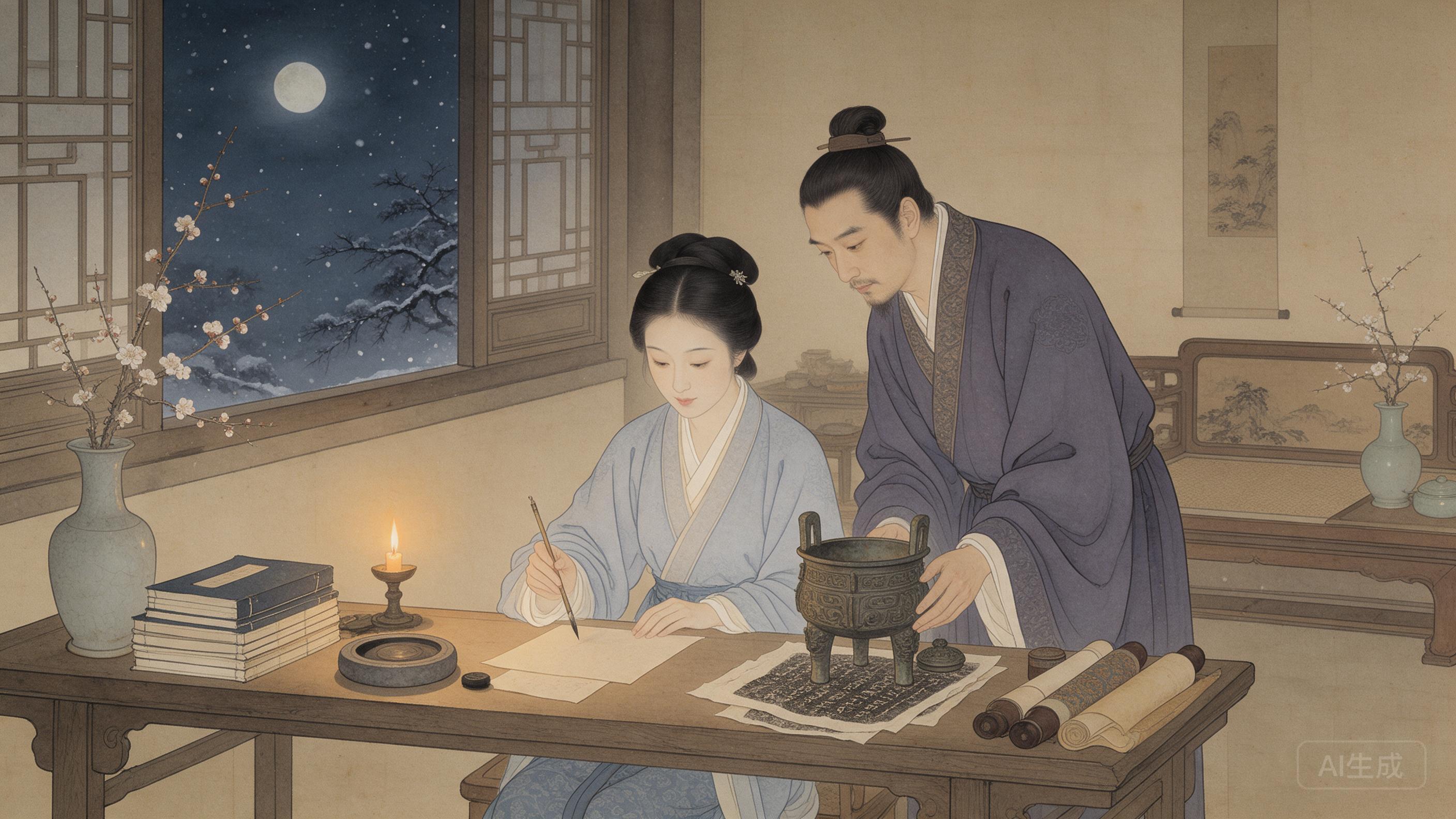
He wrote twenty characters on the mirror: “镜与人俱去,镜归人不归。无复嫦娥影,空留明月辉.” The mirror went with the person; the mirror comes back, the person does not. No more the shadow of Chang'e; the bright moon shines on, empty.
Chang'e is the woman who fled to the moon, and a polished bronze disc was read as a moon, so a reflection inside it is Chang'e's shadow. The poem pulls one object into two: the halves can be joined; the two people cannot.
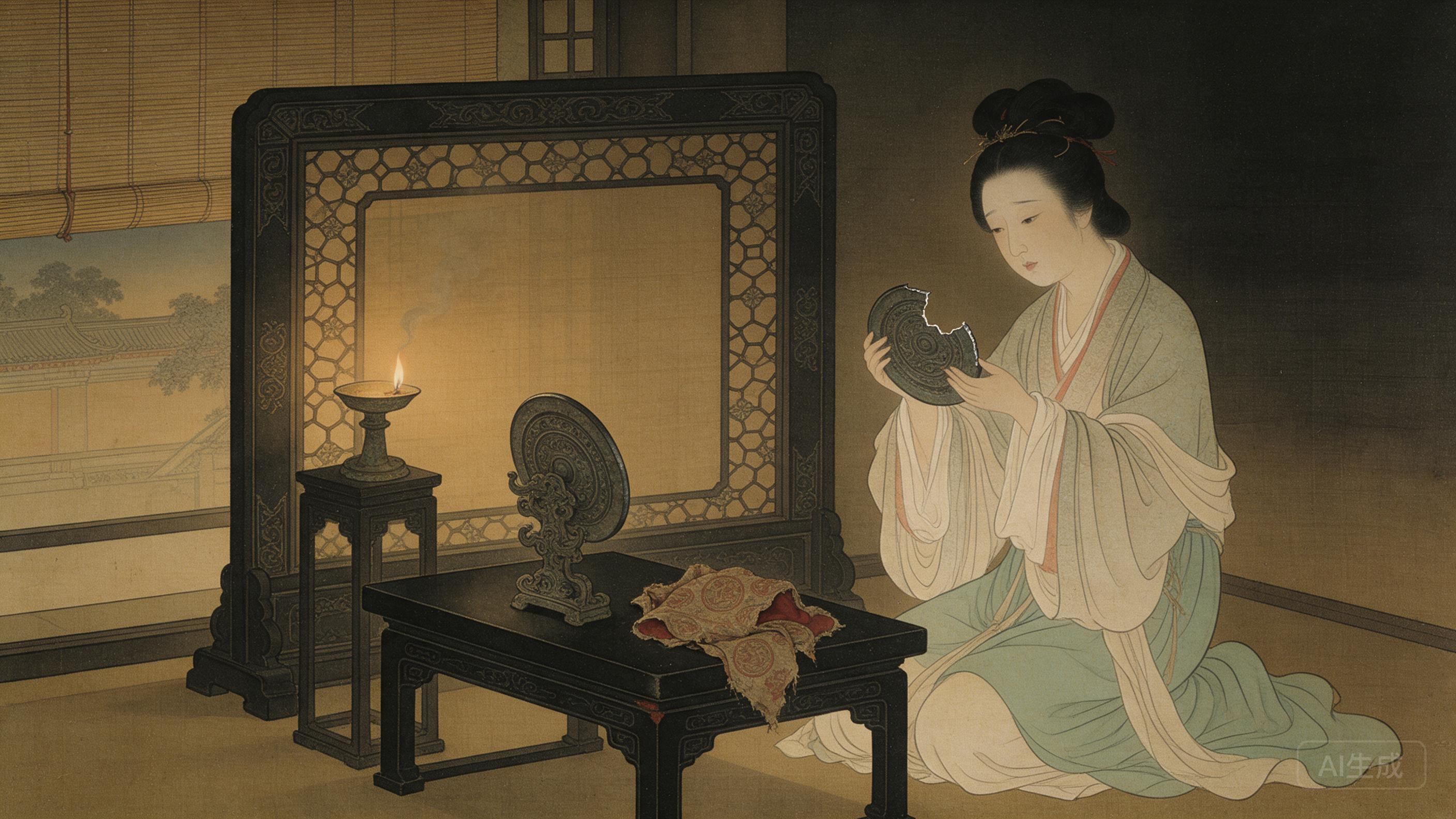
She read it, wept, stopped eating. Yang Su learned of it, and did the thing the story is remembered for. “怆然改容”: his face changed. He summoned Deyan, returned his wife with generous gifts; “闻者无不感叹,” none who heard it was unmoved. He drank with them both and asked her to compose a poem. She gave him this: “今日何迁次,新官对旧官。笑啼俱不敢,方验作人难.” What a shifting of places today — the new master facing the old. I dare not laugh and dare not weep; now I know how hard it is to be a person. (迁次 is the language of being moved from one post to another.)
Then: “遂与德言归江南,竟以终老.” She went south to Jiangnan with Deyan and there, to the end, grew old. The anecdote stops: no town, no year, no children.
What the Story Cannot Tell Us
This is literature with a date. *Benshi shi* is not a chronicle; its method is to take a poem and supply the occasion that explains it. The two poems here are built for their frame — each turns on one clean antithesis — and whether verse or story came first, they were shaped together and meant to be retold.
The histories give only the outside: Chen's end in 589 under its last ruler, the Sui conquest, Yang Su's title of Duke of Yue — and no Princess of Lechang, no mirror, no poems. The pair reach us through a late-ninth-century writer, nearly three centuries after their world ended, and I cannot verify that either poem is by the hand the text assigns it.
Nor does Meng Qi say what became of the two halves. Later retellings — stage versions, idiom handbooks, children's books — add scenes and speeches; I have not checked them and used none here.
What lasted is four characters, 破镜重圆, “a broken mirror made whole.” The phrase is less sentimental than it looks: it does not say the break never happened, only that the two edges still fit, and that the seam shows in a whole mirror.
Sources & further reading
Editorial approach