Both were celebrated painters and calligraphers in Yuan-dynasty Wuxing. What survives of their marriage is a handful of paintings, an epitaph — and a poem about clay that first appears 280 years after her death.
Her dates, family, titles and burial rest on Zhao Mengfu's epitaph for her, on the Yuan shi biography of Zhao (juan 172), on Tao Zongyi's Shu shi hui yao (juan 7) and on paintings in museum collections. Four things are not documented: any Yuan-dynasty text of the mud poem or of the concubine episode around it; a single marriage year, since English sources give 1286 and Chinese chronological tables 1289, which is why this article says "the late 1280s"; any reliable number of children, because the summaries conflict; and Zhao's age when the lyric is supposed to have been written.
01 Two families in Wuxing
Zhao Mengfu was born in 1254 in Wuxing, the town now called Huzhou, into the Song imperial line; the Yuan shi calls him an eleventh-generation descendant of Zhao Kuangyin, the dynasty's founder. Guan Daosheng was born in the same town in 1262, the daughter of Guan Shen. Her epitaph, written by Zhao, opens by giving her name and place: 夫人讳道昇,姓管氏,字仲姬,吴兴人也 — "the lady's personal name was Daosheng, of the Guan clan, courtesy name Zhongji, a native of Wuxing."
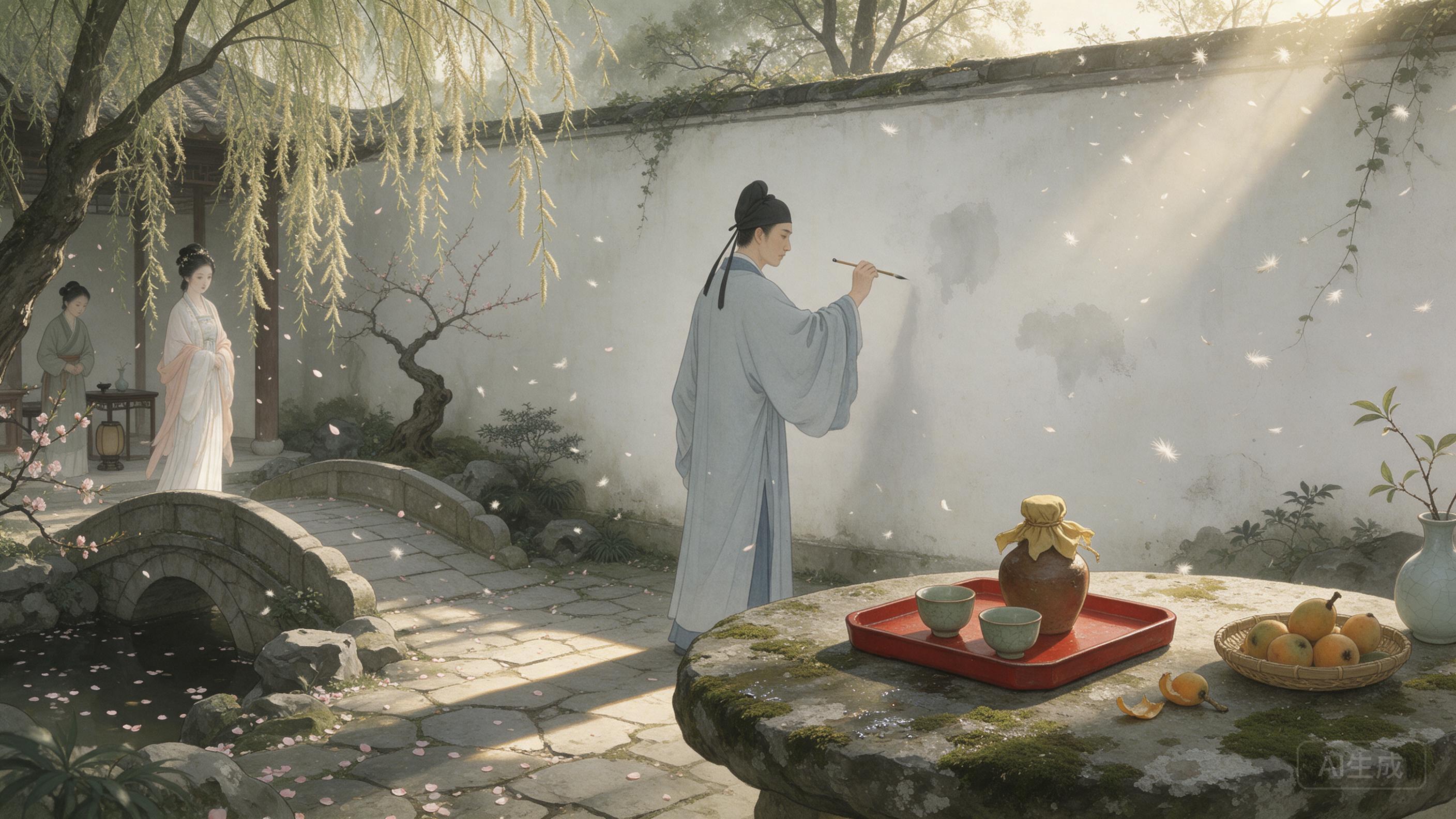
What each brought to the household was, first of all, a brush. She painted ink bamboo, plum and orchid, and also worked in landscape, Buddhist figures, poetry and calligraphy. He was the celebrated one in his own lifetime. The Yuan shi says that in seal, clerical, regular, running and cursive scripts he stood unrivalled past and present, and that a monk from Tianzhu came tens of thousands of li to seek his writing. After 1286 he served the Yuan court and rose to Hanlin Academician Recipient of Edicts. The marriage itself is usually placed in the late 1280s.
02 The same studio
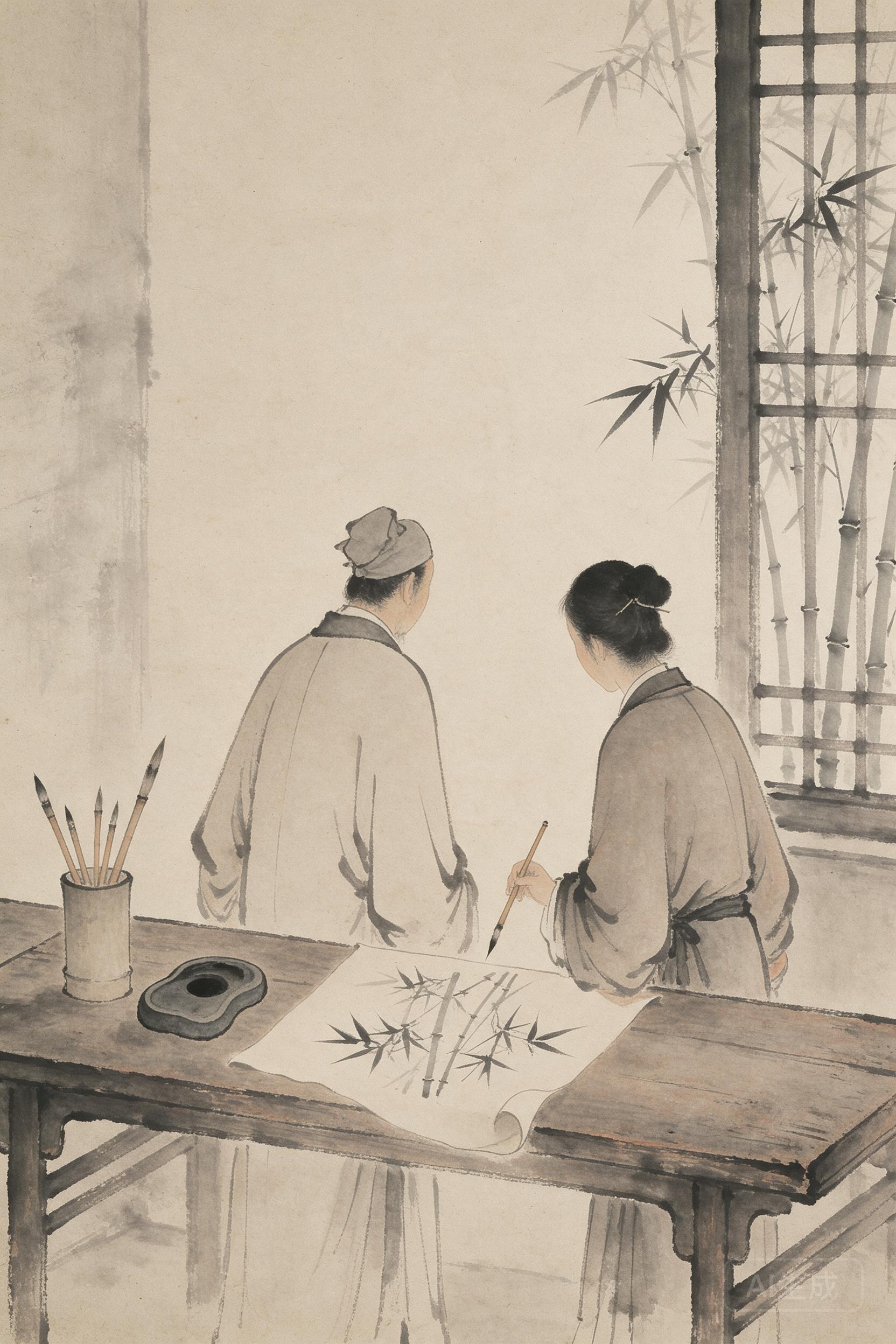
The two worked in one studio, and the record of it is mostly paintings. Bamboo and Stone, ink on paper, is in the National Palace Museum, Taipei. A water-bamboo handscroll is dated 1308 and kept in the Palace Museum, Beijing. Her ink-bamboo handscroll of 1313 was later mounted in the same scroll as bamboo by Zhao Mengfu and by their son Zhao Yong, and is now known as Three Bamboos from the Zhao Household, also in Beijing. Attribution of old Chinese painting is rarely simple, but these are the works through which her hand is traced.
The clearest sign of her standing at court is an imperial one. Emperor Renzong had her calligraphy mounted together with writing by Zhao Mengfu and Zhao Yong, and ordered it kept in the Palace Library. Tao Zongyi, writing in the Ming dynasty, records the emperor's reason in Shu shi hui yao, juan 7: 使后世知我朝有一家夫妇父子皆善书也 — "so that later ages will know that in our dynasty one household, husband, wife and son, were all good at calligraphy."
03 Two lumps of clay
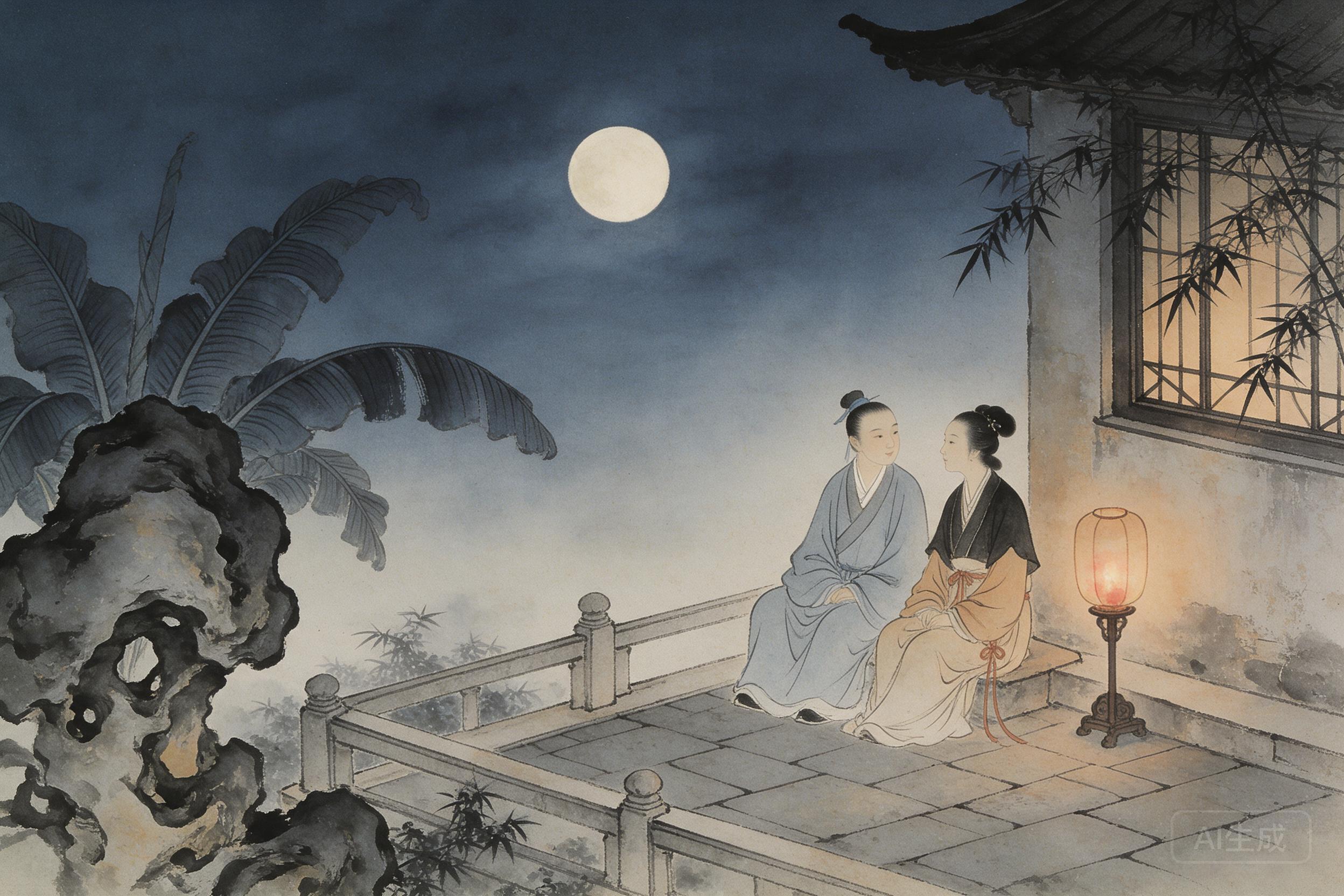
The poem most often printed under her name is an answer. According to the story, Zhao Mengfu wrote a teasing lyric about the concubines he might take, naming scholars who kept singing girls, and she replied in the same measure. In her answer two lumps of clay are kneaded, one for him, one for her, then broken, mixed with water and shaped again: 我泥中有你,你泥中有我, "in my clay there is you, in your clay there is me." The poem ends by asking for one quilt in life and one coffin in death.
The earliest text is in Yao shan tang wai ji, juan 70, a notebook by Jiang Yikui printed in the Wanli period (1573–1620), some 280 years after her death. No Yuan source contains it. The Ming book dates nothing and gives no age for Zhao; "at fifty" is a later addition. As a document the poem is unsupported; as a story later told it explains a great deal: a marriage argument made with kitchen material, images concrete enough to keep, lines short enough to remember. It is why most readers know her name at all.
04 The boat in Shandong
In 1317 she was enfeoffed Lady of the State of Wei, and from then on the sources call her Lady Guan. She died two years later, in 1319, aged fifty-eight by Chinese reckoning, after a long illness, on board an official boat in Shandong, where Zhao had asked for leave to take her south. He died in 1322 and was buried beside her at Dongheng, near Deqing. The family garden at Lianhuazhuang in Huzhou and the Dongheng tomb have been restored. At the head of what we know about her stands his epitaph.
What survives of her is painting and calligraphy, not the poem: the Taipei Bamboo and Stone; the 1308 water-bamboo scroll; a joint letter scroll with Zhao; a collaborative orchid-and-bamboo scroll at the Metropolitan Museum of Art; and a 1302 Guanyin after Wu Daozi in Osaka. Her Fisherman lyric, attributed to her and preserved in the same juan of Yao shan tang wai ji, runs: 人生贵极是王侯,浮利浮名不自由。争得似,一扁舟,弄月吟风归去休。 — "The highest rank is prince or marquis; floating profit and floating fame are not freedom. How should one match a single boat, playing with the moon, chanting in the wind, going home?"
Sources & further reading
- 魏国夫人管氏墓志铭 (in 松雪斋外集), Zhao Mengfu's epitaph for his wife — primary source for her name, family and titles; consulted through the footnotes of the Chinese Wikipedia article
- 元史 卷172 赵孟頫传 — official history; source for his lineage, offices, death in 1322 and the line 子雍、奕,并以书画知名
- 尧山堂外纪 卷070 (维基文库) — Ming notebook by Jiang Yikui; earliest known text of the mud poem and of Zhao's teasing lyric, ending 松雪得词,大笑而止
- Guan Daosheng, Wikipedia (English) — background overview and bibliography for the paintings and the 1317 title