Sixty characters on a garden wall outlasted the wall, the garden and the marriage. What can be documented about Lu You's Chaitoufeng, and what belongs to eight centuries of retelling.
The poem's text is secure, but the biography behind it is not. Chen Hu, the earliest account (early thirteenth century), already has the wall, the wine, an answer he could not recover in full, and the date 1151; Liu Kezhuang, a generation later, keeps only a divorce and a glance; Zhou Mi (1290s) supplies the surname, her father Tang Hong, the niece claim and the date 1155. The name Tang Wan appears only in late Qing and early Republican scholarship, and the full reply lyric attributed to her is absent from Song sources, so it is presented here as tradition rather than evidence.
A wall in Shen Garden
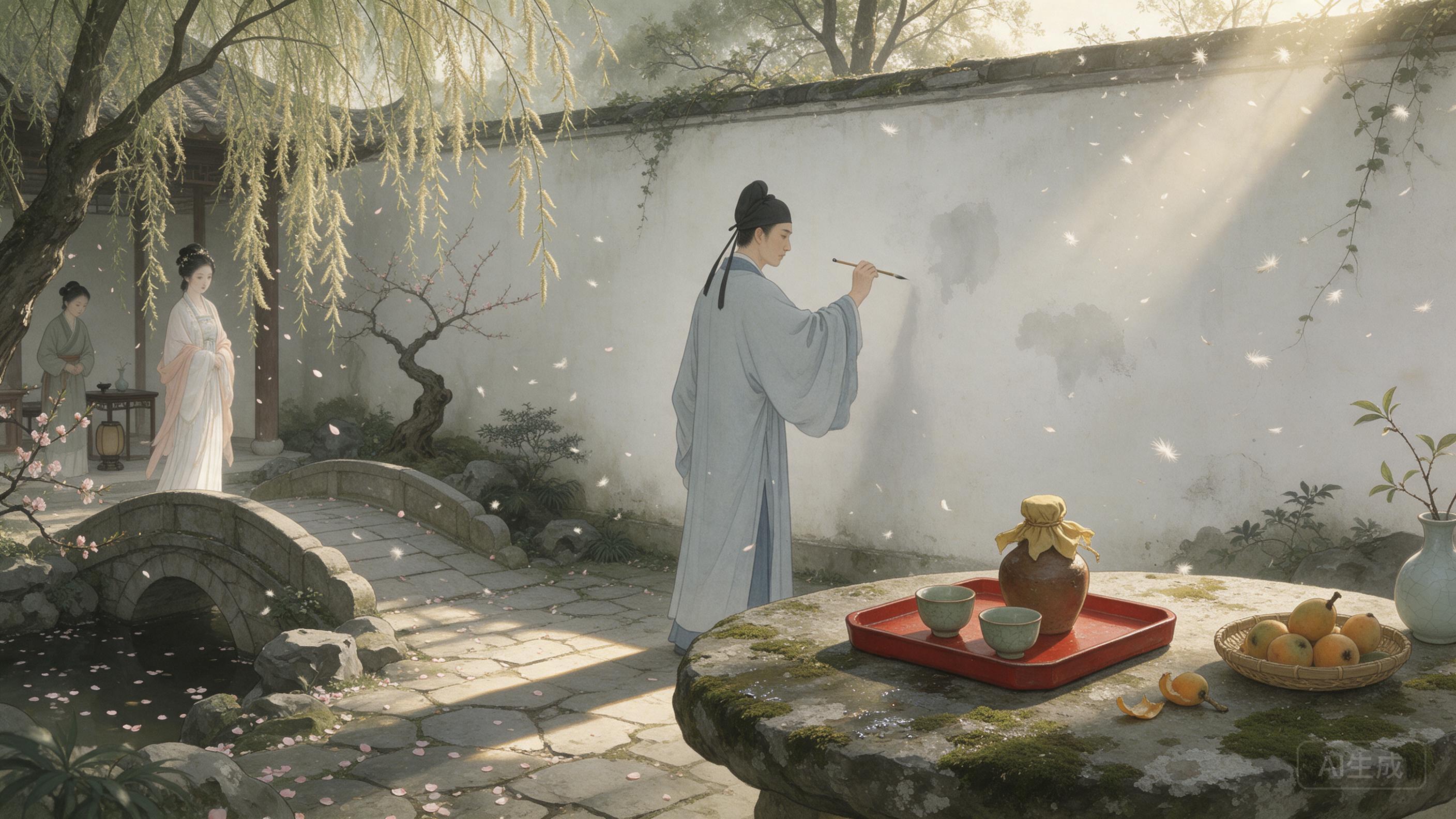
Shen Garden lay south of the Yuji Temple in Shanyin, the town now called Shaoxing: walled, private, and in late spring almost oppressive with green. There, in the 1150s, the story goes, a man of about thirty met the wife his mother had forced him to divorce. She was out for the day with the husband she had been given instead, a distant member of the imperial Zhao clan. She sent over wine, fruit, a dish or two; a servant carried the tray across the grass. He drank, took up a brush, wrote sixty characters on the wall, and left.
The scene cannot be documented. The poem can.
The poet and the marriage
Lu You (1125–1210) is among the most prolific poets in the canon: roughly 9,300 poems survive. His public life was a long frustration: for decades he urged war to recover the north from the Jurchen and was never allowed to fight it. Around 1144 he married a woman of the Tang family. The sources agree the two were devoted and that his mother broke the marriage; they disagree about why. No child yet, too much distraction from study, simple dislike: the explanations are late, none contemporary. In a household where a son could be ruined by a charge of impiety, a mother's displeasure was enough. He sent her back to her family. She married Zhao Shicheng.
Then the detail that matters most: he never once wrote her name. Nine thousand poems, not one names her.
Sixty characters
*Chaitoufeng* — "Hairpin Phoenix" — is a tune title, not a subject, though a phoenix hairpin is an ornament made to break. Thirty characters to a stanza, and each stanza ends not with a line but with a single word struck three times.
> 紅酥手,黃縢酒,滿城春色宮牆柳。 > 東風惡,歡情薄。 > 一懷愁緒,幾年離索。 > 錯、錯、錯。
> Red, soft hands; wine sealed under yellow cloth; a city full of spring, willows along the wall. > The east wind is vicious; pleasure was a thin thing. > A heart full of grief; years of separation. > Wrong. Wrong. Wrong.
> 春如舊,人空瘦,淚痕紅浥鮫綃透。 > 桃花落,閒池閣。 > 山盟雖在,錦書難託。 > 莫、莫、莫。
> Spring is as it always was; she is thin for nothing; tear tracks have soaked the mermaid-silk gauze red. > Peach blossom falls; the pond pavilion stands empty. > The oath still holds; a brocade letter cannot be sent. > Never. Never. Never.
What the tune does
The poem is made almost entirely of objects, and the objects keep changing hands. Red hands, reaching for a cup. Wine sealed under yellow cloth — official wine, so her courtesy is correct, and the correctness is the cruelty. Willows, the tree you break a branch from to say goodbye. The east wind, which ought to thaw the spring, is called vicious instead: wind scatters what it touches. He never names the wind. His mother is not in the poem, and neither, quite, is he.
The reply attributed to Tang Wan
A second lyric answers his, stanza for stanza, and is usually printed under her name. Its three hammered words fall inward rather than outward — *hard*, *hard*, *hard*, then *hide it*, *hide it*, *hide it* — as if grief were a thing to be swallowed. The attribution, however, is late and unproven: no Song text contains the complete reply.
What the Song notebooks record
The record does not thin as you go back. Chen Hu, the earliest witness, writing in the early thirteenth century, says he saw the wall himself as a young man, dates the inscription to the third month of 1151, adds the wine and fruit, reports that she answered him — he could never obtain the whole stanza — and says she died soon afterwards. Liu Kezhuang, a generation later, keeps almost none of this: the divorce without a name ("a woman of a certain family"), and a meeting reduced to a glance across a garden, with no tray, no wine, no brush. Zhou Mi, in the 1290s, supplies almost everything now repeated: the surname Tang, her father Tang Hong, the claim that she was a niece of Lu You's mother, and the date 1155.
So the dossier contains two dates, 1151 and 1155; a reply that surfaces only in Ming and Qing anthologies; and a name, Tang Wan, entering the record in late Qing and early Republican scholarship. The cousin claim is shaky on the evidence: Lu You's mother came from the Tang of Jiangling, Tang Hong from the Tang of Shanyin.
Return, in 1199
In 1199 he came back. The garden had changed hands and the old ponds and terraces were gone. He wrote two quatrains; in one of them, the little bridge still holds a reflection of someone who once crossed it, and the water is still green. Even those lines do not hold still: the surviving copies differ by a character or two.
What survived was not the plaster. It was the copying.
Sources & further reading
- 陳鵠《耆舊續聞》卷十(辛未三月題壁、黃封酒果饌、惜不得其全闕)
- 劉克莊《後村詩話》續集卷二(不敢逆尊者意,與婦訣;坐間目成而已)
- 周密《齊東野語》卷一「放翁鍾情前室」
- 陸游《釵頭鳳》通行文本(六十字,與陳鵠、周密所錄互校)