Shen Fu and Chen Yun were cousins, then husband and wife, then — for the twenty-three years until her death — two people running a household on very little. Almost everything we know of them comes from Six Records of a Floating Life, the memoir he wrote after she died in 1803. This is the story the book tells, with its dates kept and its gaps left open.
Six Records of a Floating Life is autobiographical prose, not fiction. Shen Fu wrote it after his wife died, choosing which scenes to keep and shaping them into something close to art; it is strong evidence of a marriage, but it is not a verbatim record, and it tells us as much about how he remembered as about what was said. The people, places and dates below rest on the text and on Yu Pingbo's chronological table. Operas, television dramas such as Yun Niang, and the modern packaging of the couple as "China's most beautiful love story" are later re-creations and modern reception. Lin Yutang's praise dates from 1935.
A bowl of congee
Shen Fu was born in 1763 in Changzhou, the old county town inside Suzhou; Chen Yun, courtesy name Shuzhen, came from neighbouring Wuxian. She was his elder cousin, born in 1763 — "the same age," as he wrote, "and she ten months my senior."
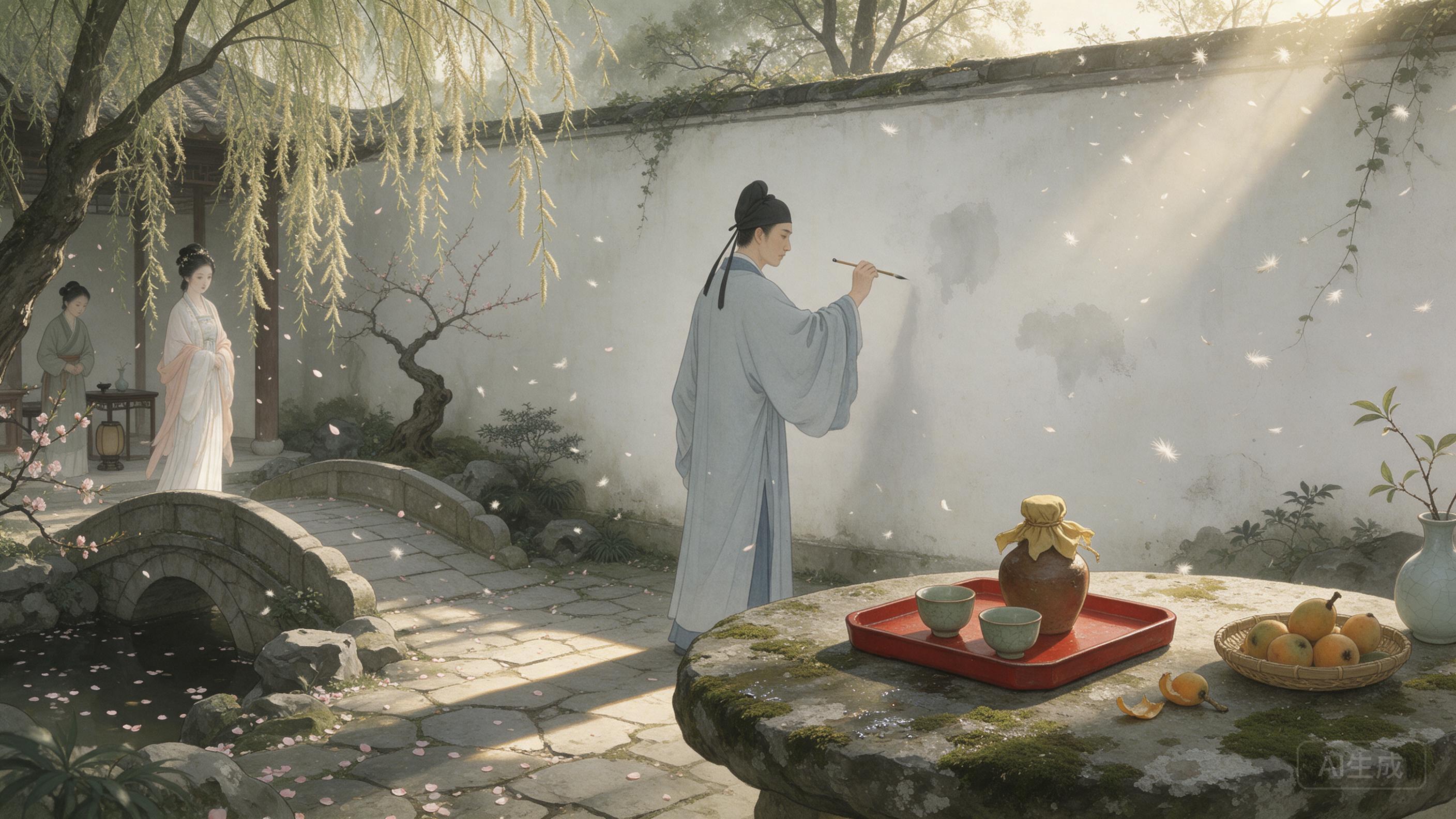
They were betrothed in July 1775, when both were thirteen. What Shen Fu kept from that year is not a declaration but a bowl of congee. At a family wedding that winter, hungry, he was drawn by Chen Yun into her room, where she brought out warm congee and side dishes she had set aside. He had barely lifted his chopsticks when her cousin Yuheng came in and teased them. Shen Fu records the embarrassment, not a vow.
They married in 1780, on the twenty-second day of the first lunar month in the forty-fifth year of the Qianlong reign.
Moonlight at Canglang Pavilion
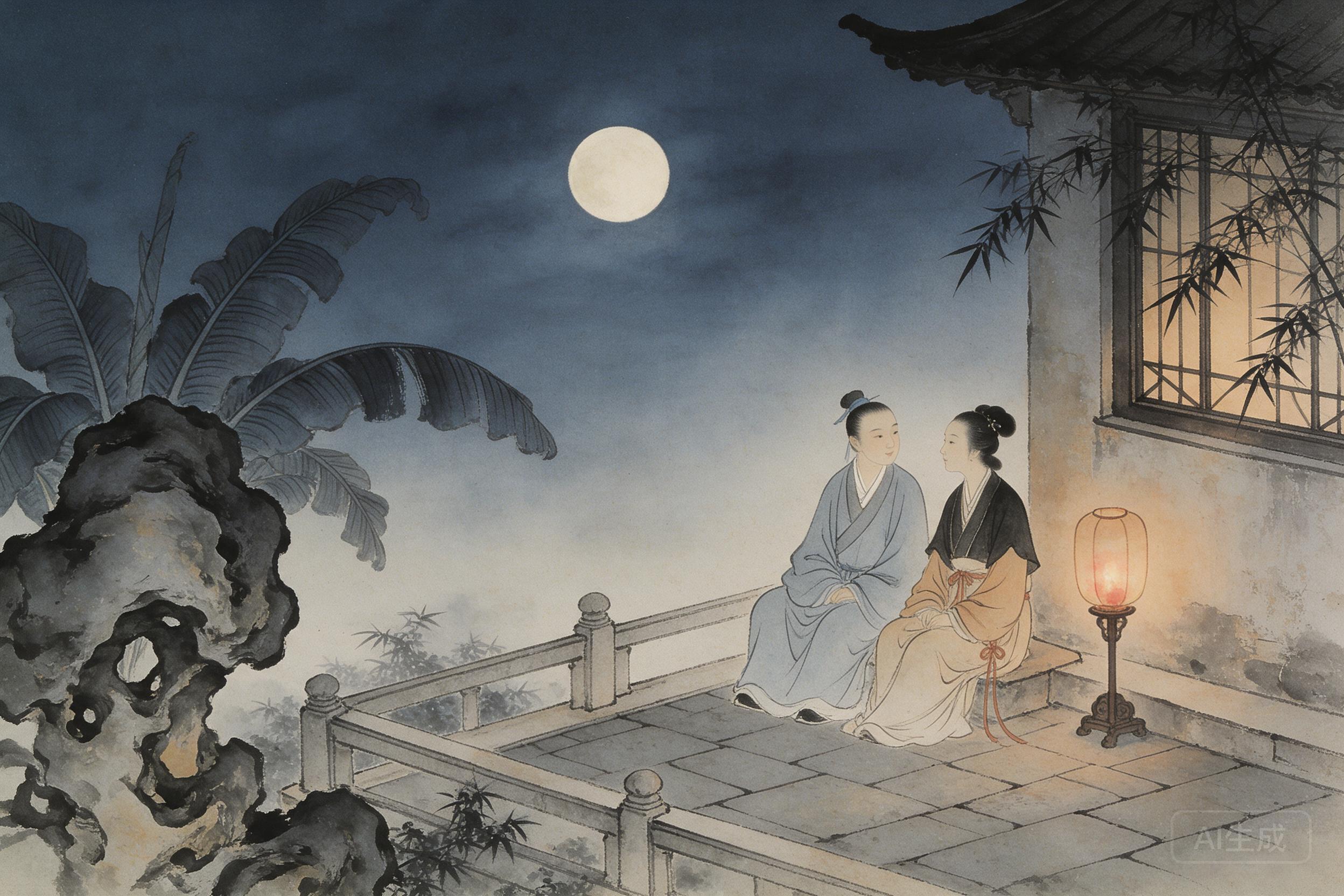
In June 1780 the couple moved into rooms they named Wo Qu Xuan, near the Canglang Pavilion in Suzhou. Those months were the clearest of their marriage: on the seventh night of the seventh month they worshipped the Weaving Girl together; at mid-autumn they walked out to the pavilion to see the moon.
Money was thin. Shen Fu worked as a private secretary and tried his hand at trade; Chen Yun sewed to help fill the gap. Two children followed: Qingjun in 1787, Fengsen in 1789. Chen Yun preferred small pleasures to comfort, and said so in a line Shen Fu recorded in the memoir: "In coarse cloth and plain rice, one may be content to the end of one's days" (布衣菜饭,可乐终身; Six Records, "Wedded Bliss"). Her verse survives in fragments quoted in the same book, including a couplet on an autumn garden: "Autumn thins the shadow of a person; frost fattens the chrysanthemums" (秋侵人影瘦,霜染菊花肥; same section).
She was also game for what was not expected of her. Wanting to see the lantern fair at the Shuixian Temple, she went in men's clothes; when she brushed against a young woman and was scolded, she took off her cap, showed she was a woman too, and the quarrel turned to laughter.
The years at Xiaoshuang Tower
In 1792 Shen Fu's father, angered by a family matter, turned Chen Yun out. The couple sheltered in the Xiaoshuang Tower, belonging to their friend Lu Banfang, and lived on his brush and her needle. In 1794 his father called her home; the household's troubles were not over.
What followed is usually read as the turning point. In 1795, at Tiger Hill outside Suzhou, Chen Yun met a young woman named Hanyuan and grew fond of her; later they became sworn sisters, and Chen Yun hoped to bring her into the household as Shen Fu's concubine. In 1796 a man of greater power took Hanyuan away. Chen Yun's old illness worsened, and the affair added to the family's disapproval. The memoir says little about Hanyuan's own feelings; better not to fill the silence.
In "The Sorrows of Hardship" (坎坷记愁) Shen Fu is hard on himself: her troubles, he writes, came chiefly from family misunderstandings, debts, and his failure to manage their livelihood. He calls her "a good friend within the women's quarters." That is a husband's judgment of himself, written years later, not a neutral report.
Yangzhou, and the book that survived
In the winter of 1800 the couple left Suzhou and stayed with a friend, Hua Dacheng, at Donggaoshan in Wuxi. In 1802 Shen Fu rented two rooms by the river outside the Xianchun Gate in Yangzhou; in the tenth month Chen Yun arrived with their maid, A Shuang.
The spring of 1803 was bad. Chen Yun began coughing blood; Shen Fu travelled to Jingjiang to borrow money; the maid ran off. Chen Yun died in Yangzhou on 21 April 1803 — the thirtieth day of the third lunar month, in the eighth year of the Jiaqing reign — aged forty-one by Chinese reckoning. Her coffin rested for a time at Jingui Shan, outside the west gate.
He wrote the memoir afterwards; the fourth section is dated 1808. Four of the planned six survive, and later "complete" editions are regarded as forgeries. The four circulated in manuscript until Yang Yinchuan bought a damaged copy at a Suzhou book stall and gave it to Wang Tao, who printed it in Shanghai in 1877 (some sources say 1878). It became a bestseller; Lin Yutang's English translation appeared in 1936, and in a preface dated 1935 he called Chen Yun "the most lovable woman in Chinese literature" — a twentieth-century judgment, not a verdict of her own time.
The title comes from Zhuangzi: life is like something floating, death like rest. What the book keeps is a bowl of congee, a moonlit garden, and two rented rooms by a river.
Sources & further reading
- Six Records of a Floating Life — Wikipedia (overview; background only)
- 浮生六記 — 维基文库(一次文本,两处引文依据)
- 陈芸(沈复妻子)— 维基百科(生卒、年表依据)
- 浮生六记 — 维基百科(版本与林语堂译序;仅作背景)