In 628 a young man stopped at an inn outside Songcheng and rose before dawn to meet a prospective bride's family. Instead he met an old man reading a ledger by moonlight, who told him that his marriage had been settled years earlier, to a three-year-old girl in rags. The story that follows, preserved in the Taiping Guangji, gave Chinese two of its most durable images: the matchmaker under the moon and the red cord that binds a couple before they ever meet.
The story is preserved in juan 159 of the Taiping Guangji, the Song anthology compiled in 977-978, which attributes it to the Tang writer Li Fuyan's Xu xuanguai lu (Further Records of the Mysterious and Strange), cited there under the variant title Xu youguai lu. It is a chuanqi tale, literary fiction rather than chronicle; the second year of the Zhenguan era corresponds to 628. The translation keeps the original order of scenes and renders official titles loosely (prefect for cishi, assistant governor for sima, registrar for sihu yuan). The received text is corrupt where the wife's own title is recorded (Taiyuan qun zuo furen, apparently a scribal error), so no specific title is given. The huadian was a Tang facial ornament cut from gold, silver, shell or paper and pasted between the brows; the old man's later standing as a god of marriage belongs to the tale's reception, not to the tale itself.
A Meeting Set Before Dawn
In 628, the second year of the Zhenguan era, a young man named Wei Gu travelled from Duling toward Qinghe. An orphan, he wanted to marry early; every inquiry had come to nothing. At Songcheng he lodged at an inn south of the town; a match had been proposed with the daughter of Pan Fang, formerly assistant governor of Qinghe, and a meeting was set for the next morning at the Longxing Temple gate.
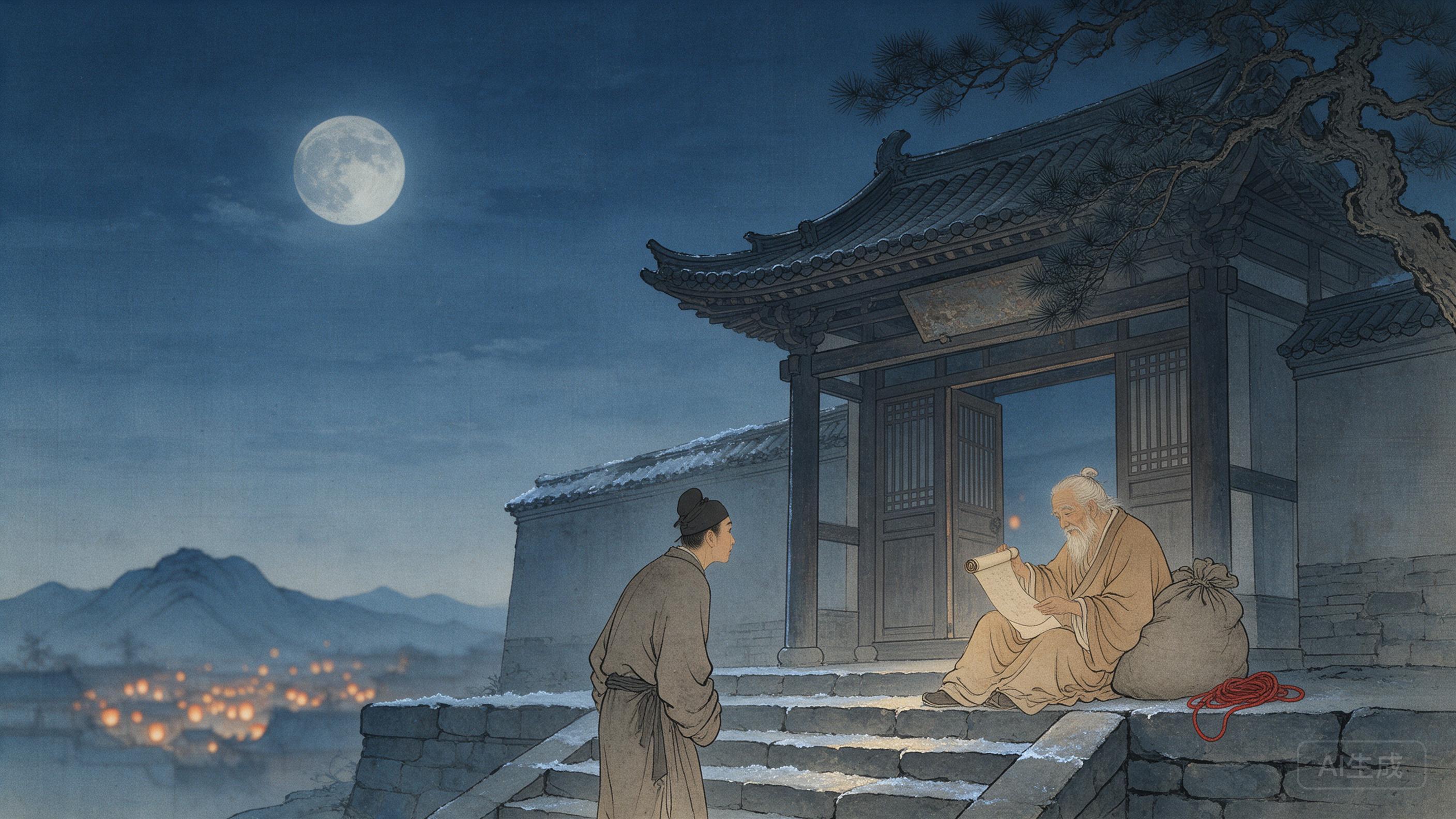
He went before daylight; the moon was still up. On the temple steps an old man sat leaning on a cloth bag, reading a book by moonlight. Wei Gu had studied since childhood and could read even Indian script, but not this. The book was not of this world, the old man said: it was a ledger of the underworld. Clerks of the underworld manage the affairs of the living, he explained; travellers on any road are half people, half ghosts, and no one can tell them apart. His department was the empire’s marriage registers.
The Red Cord
Wei Gu was pleased: he wished to marry early for descendants, and every channel had failed. Would tomorrow’s negotiation with the Pan family succeed? “No,” the old man said. “Your wife is three years old. At seventeen she will enter your house.”
The bag held red cords for tying the feet of husbands and wives, knotted invisibly while they sit. Enemy households, ranks far divided, Wu and Chu at opposite ends of the world: once tied, none of it can be escaped. “Your feet are already tied to hers. What use is looking elsewhere?”
The girl was the vegetable seller’s daughter, north of the inn. At daybreak the old man walked into the market, where a one-eyed woman carried a three-year-old girl, both miserably shabby. “That is your wife,” he said, and vanished. Wei Gu asked whether he might kill her. The child is destined for high emolument, he was told, and will hold a fief through her son; she cannot be killed.
A Knife in the Vegetable Market
He tried. He ground a small knife and gave it to a trusted servant for ten thousand cash, sending him into the vegetable stalls. The servant stabbed the child in the crowd and ran; the market erupted and he escaped. Had he struck home? “I went for the heart,” the servant said. “I only got her between the brows.”
His marriage plans went nowhere for fourteen years. Then, through his father’s rank, he entered the military administration of Xiangzhou; the prefect Wang Tai made him acting registrar over judicial cases and gave him his daughter, then sixteen or seventeen.
The Flower Between Her Brows
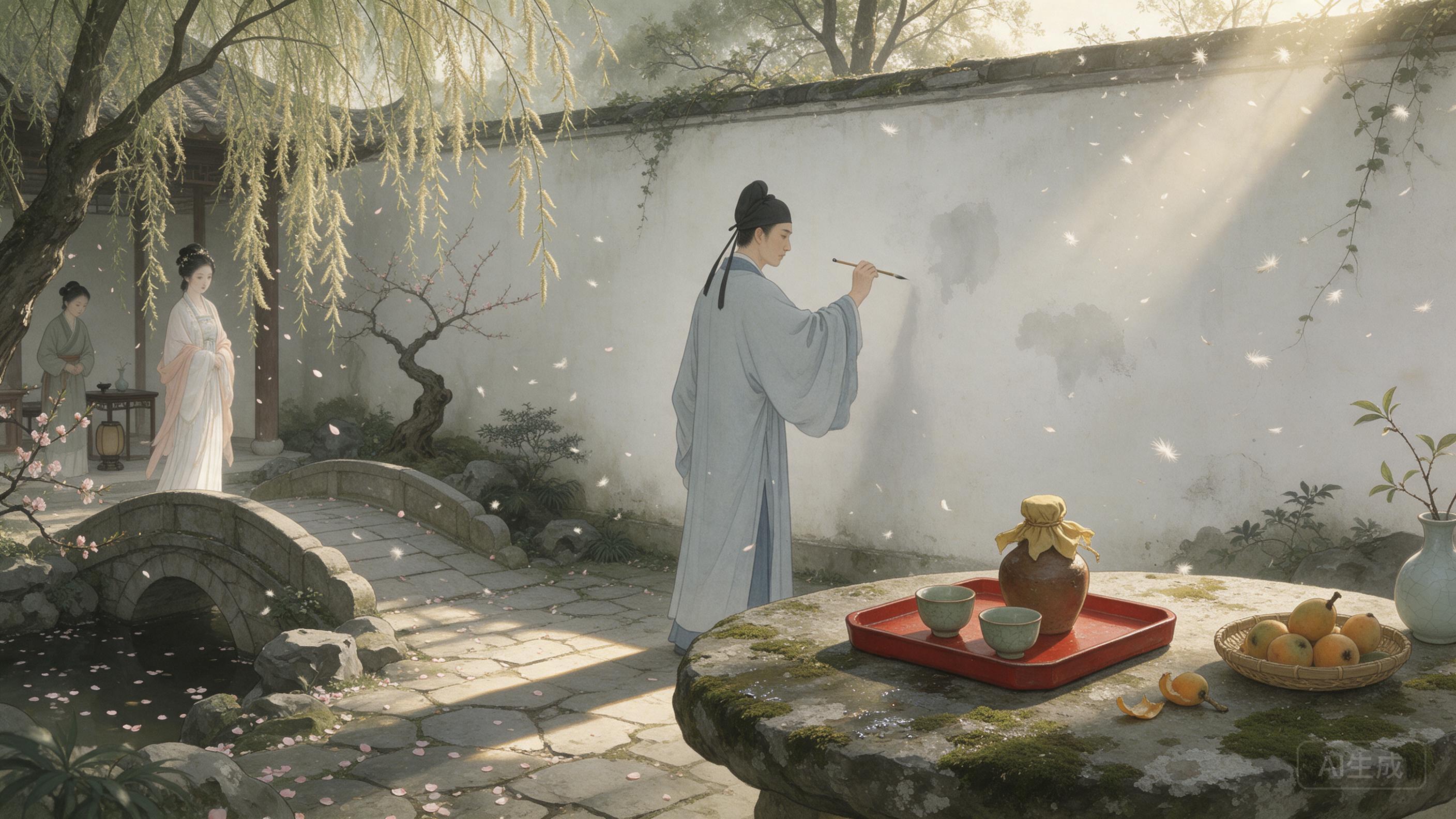
She was beautiful and he was delighted, but she wore a flower ornament, a huadian, pasted between her brows, and never removed it, not even bathing. After a year he insisted; she wept. She was the prefect’s niece, not his daughter: her father had been magistrate of Songcheng and died in office while she was an infant; her mother and elder brother died soon after. She had lived south of town with her wet nurse, a woman named Chen, selling vegetables. At three she was carried through the market, where a madman stabbed her; the scar remained, and the flower covered it. Seven or eight years later an uncle serving at Lulong took her in and later married her to him. Was Chen one-eyed? She asked how he knew. “Because I am the man who stabbed you,” he said, and told her everything.
What the Tale Left Behind
The Taiping Guangji, the Song anthology, prints it in juan 159 under “Fixed Destiny, Fourteen: Marriage” and names Li Fuyan’s Tang collection Xu youguai lu. The story does not care whether Wei Gu is punished. It cares that his crime cannot succeed: the cord was tied before either party could consent, and the knife that should have ended a life supplied the mark by which a husband would recognise his wife. The flower ornament, a real Tang fashion cut from gold, silver, shell or paper, is the hinge: a cosmetic habit hides the wound, and discretion preserves the evidence. Hearing the story, the magistrate of Songcheng named the inn Dinghun dian, the Inn of Fixed Marriage.
The tale gave Chinese two durable images: the red cord that binds a couple before they ever meet, and the old man himself, yuexia laoren, the matchmaker under the moon. In the Tang text he has no shrine, no incense and no name — a clerk on a temple step with a ledger and a bag, working by moonlight. The god of marriage came later, when a story about fate’s indifference had been smoothed into a story about happiness.
Sources & further reading
Editorial approach