In the fourth century CE, a collector of strange tales wrote down something he said had happened six hundred years earlier, in the state of Song: a king, a retainer, a wife who chose death over obedience, and two trees that would not stay apart. It is short, brutal, and one of the earliest recorded versions of a word Chinese poetry never let go of.
The narrative follows the received text of Gan Bao's In Search of the Supernatural (《搜神記》), juan 11; the Wikisource transcription also records the tale in the Fayuan Zhulin (juan 36) and the Yiwen Leiju (juan 40). Han Ping and He Shi do not appear in the standard histories. The king is usually identified with King Yan of Song (king from 318 BCE, state destroyed in 286 BCE) in the Records of the Grand Historian, but the graves, the catalpa trees and the mandarin ducks belong to the tale, not to the archive.
A retainer's wife
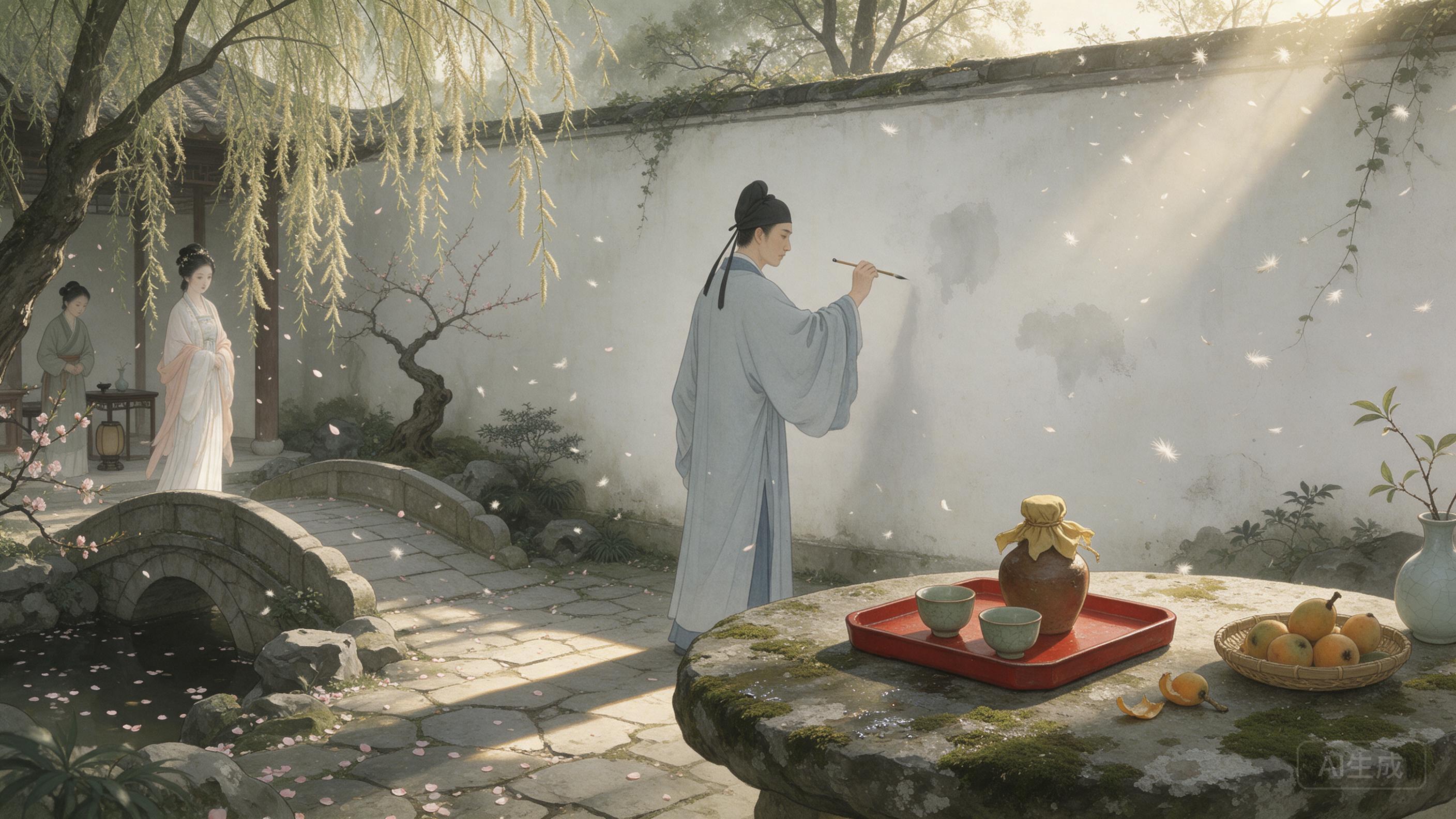
Han Ping served as a 舍人 — a retainer, a household officer — at the court of the King of Song. He was married to a woman of the He family, remembered only as He Shi, "Lady He". The record gives her no name of her own; it gives her a reputation for beauty, and that is where the trouble starts. The king, known to later tradition as King Kang of Song, saw her and took her into his palace.
The text's word is 奪 — to seize. It does not describe a negotiation, a divorce, or a second marriage. A powerful man removed another man's wife, and the court understood exactly what had happened.
Han Ping complained. The punishment was immediate: imprisonment and a sentence of 城旦, the hard labour of building walls — in Warring States and Qin-Han law a term of years in state service, not a fine that could be paid off.
This story never gives her a name. She is 何氏 — "a woman of the He family" — and her beauty, her letter and her death are all reported by other people. The only words in the text that are hers alone are the note left in her belt.
Three lines that were not a poem
Cut off from his wife, Han Ping received a letter. It was written in deliberate riddles: 「其雨淫淫,河大水深,日出當心。」 — "The rain falls and falls; the river is wide and the water deep; the sun rises and strikes the heart."
The king intercepted it and showed it to his attendants. None of them could read it. Then a courtier named Su He explained: endless rain meant grief and longing; a wide river and deep water meant the two of them could not reach each other; the sun at the heart meant she had resolved to die.
It is one of the earliest love letters in Chinese fiction, and it contains almost no tenderness. Every line is a report on a situation and a decision. The kind of writing later labelled 志怪 — records of the strange — loves this device: a message that looks like weather and is actually a plan.
Two deaths, one refusal
Soon afterwards, Han Ping killed himself.
His wife, the text says, secretly rotted her own clothing (陰腐其衣) — a detail that reads as cold calculation and, in the logic of the story, as love.
The king took her up onto a terrace. She threw herself from it. The attendants reached out to catch her, and the garment came apart in their hands (衣不中手). In her belt they found a note: "The king wants me to live; I want to die. I ask only that my bones be given to Han Ping, to be buried with him."
The king was furious and refused. He had them buried by the villagers in separate graves, set within sight of each other (冢相望). Then he mocked them: "You two love each other without end — if you can make the graves join, I will not stop you."
Roots below, branches above
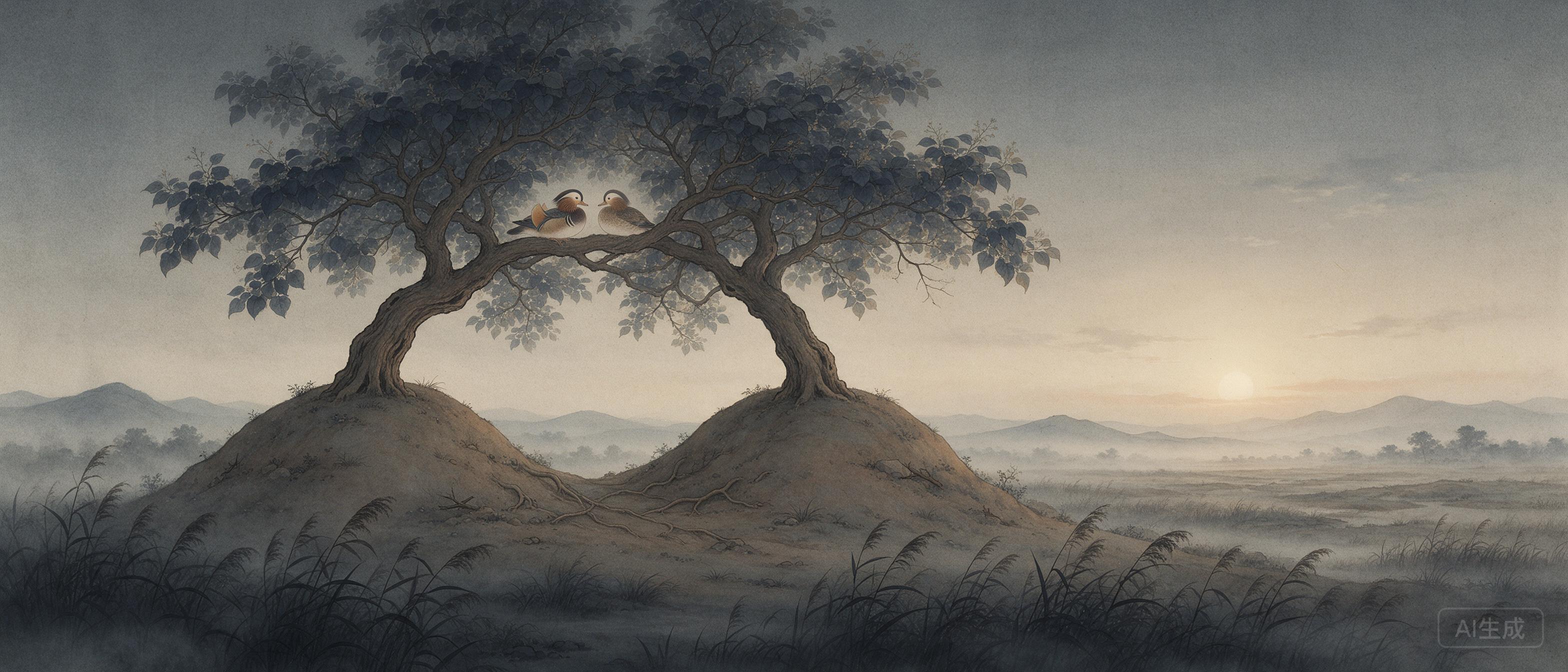
Within a single night, a catalpa tree (梓木) grew from each grave mound. Within ten days the trunks were too thick to embrace. They bent toward each other; their roots joined underground and their branches crossed above. A pair of mandarin ducks, one male and one female, came to live in the canopy, stayed morning and evening, and called with their necks twined together.
The people of Song named the trees 相思樹, "the tree of mutual longing". The text adds that the name 相思 — the word Chinese poetry still uses for the ache of separation — began here. Gan Bao's hand is restrained at this point: no oracle, no retribution, only the pity of bystanders giving a tree its name. Southerners said the ducks were the couple's souls. In Suiyang, the record notes, there was a Han Ping fortress, and the songs about them were still being sung when the story was written down.
What the story is, and what it is not
The story survives because Gan Bao, an Eastern Jin official with an interest in anomaly accounts, put it into In Search of the Supernatural, a fourth-century collection of strange happenings. He reports it as something that happened; he offers no archives. Han Ping and He Shi are not recorded in the standard histories.
The king is. In the Records of the Grand Historian, the ruler of Song in this period is King Yan, who took the royal title in his eleventh year, was criticized for drunkenness and indulgence in women, and lost his state to the armies of Qi, Wei and Chu in 286 BCE. Later tradition remembered him as a byword for the bad king. That is the historical frame the story is set in — a real reign, filled in with a tale that no contemporary source records.
The catalpa and the ducks are the story's argument, not its evidence. What the text can support is smaller and more interesting: that by the fourth century CE, a story about a couple destroyed by power, and about a landscape that answered for them, was already old enough to have place names and songs attached to it.
If you go looking for 相思 in later Chinese poetry, this is one of the places it comes from: not a metaphor invented by a poet, but two graves, two trees, and a name the neighbours gave them.
Sources & further reading
Editorial approach