Written around 800, in the Zhenyuan reign of Emperor Dezong, Yuan Zhen's Yingying zhuan (Yingying's Story) survives complete in the Northern Song anthology Taiping guangji, which printed it in juan 488, in the section of miscellaneous biographies. The tale dates itself twice over: the girl is born in the seventh month of 784 and is seventeen in 800. It takes its title from a friend's ballad, and it does not end in a wedding.
Text: the story survives complete in the Northern Song anthology Taiping guangji, juan 488, under the title Yingying zhuan and ascribed to Yuan Zhen, and everything retold here comes from that text, in which Zhang Sheng never receives a personal name; the siege at Pu, the west-wing meetings and Zhang's speech on dangerous beauty are incidents of the fiction, not of recorded history. Wang Shifu's Yuan-dynasty play The Western Wing later gives the lovers a happy ending and supplies Zhang Sheng's names, additions absent from the Tang tale. Versions: a Song preface already observes that the tale was not preserved in Yuan Zhen's collected works and reached readers through fiction, and the Siku edition of the Yuan shi changqing ji does not contain its full text, so the story survives chiefly through story anthologies; the tradition that it records Yuan Zhen's own experience, argued in the Song by Wang Xingzhi's Chuanqi bianzheng, remains a traditional reading rather than a fact.
01 A tale preserved by anthology
The Yingying zhuan, "Yingying's Story," also called Huizhen ji, is set in the Zhenyuan reign (785–805) and usually dated to about 800. Its author, Yuan Zhen (779–831), was a Henan man; he passed the two-classics examination at fifteen and took first place in the 806 decree examination. It survives because the Northern Song anthology Taiping guangji printed it in juan 488, headed Yingying zhuan and ascribed to Yuan Zhen.
02 Two families at Pujiu
In the tale a young man known only as Zhang Sheng, twenty-three and never yet near a woman, lodges at the Pujiu monastery east of Pu when the garrison breaks: General Hun Jian dies at Pu, the officer left over the troops cannot hold them, and the soldiers plunder the countryside. A Cui widow bound for Chang'an is stranded there with her children. The text is precise: she is a Zheng daughter, Zhang too descends from the Zheng, and she is his collateral cousin-aunt of a different branch, distant kin on his mother's side; she addresses herself to him as "aunt." Zhang asks officers he knows for guards, and the family lives. At the meal she gives in thanks she brings out her son Huanlang, just over ten, and Huanlang's elder sister Yingying, born in 784 and seventeen in 800.
03 The maid's plain proposal
Zhang wants her and finds no way in. He sends gifts to her maid until she will speak with him; the maid is named Hongniang, not an invention of the later stage. She runs off frightened, then returns with the plainest advice in the story: the family owes him their lives, so why not ask for the girl? He refuses.
「若因媒氏而娶,納采問名,則三數月間,索我於枯魚之肆矣。」(《太平廣記》卷四八八〈鶯鶯傳〉)——"If I were to marry through a matchmaker, with the betrothal gifts and the asking of names, then within three or four months you would be looking for me in the dried-fish market."
Dried fish are sold dead; he cannot wait months of formality. Nothing external blocks him: no angry father, no rival, no rank objection. The respectable proposal is the maid's; the man declines it over the calendar and takes her fallback suggestion, a poem.
04 A wall and a rebuke
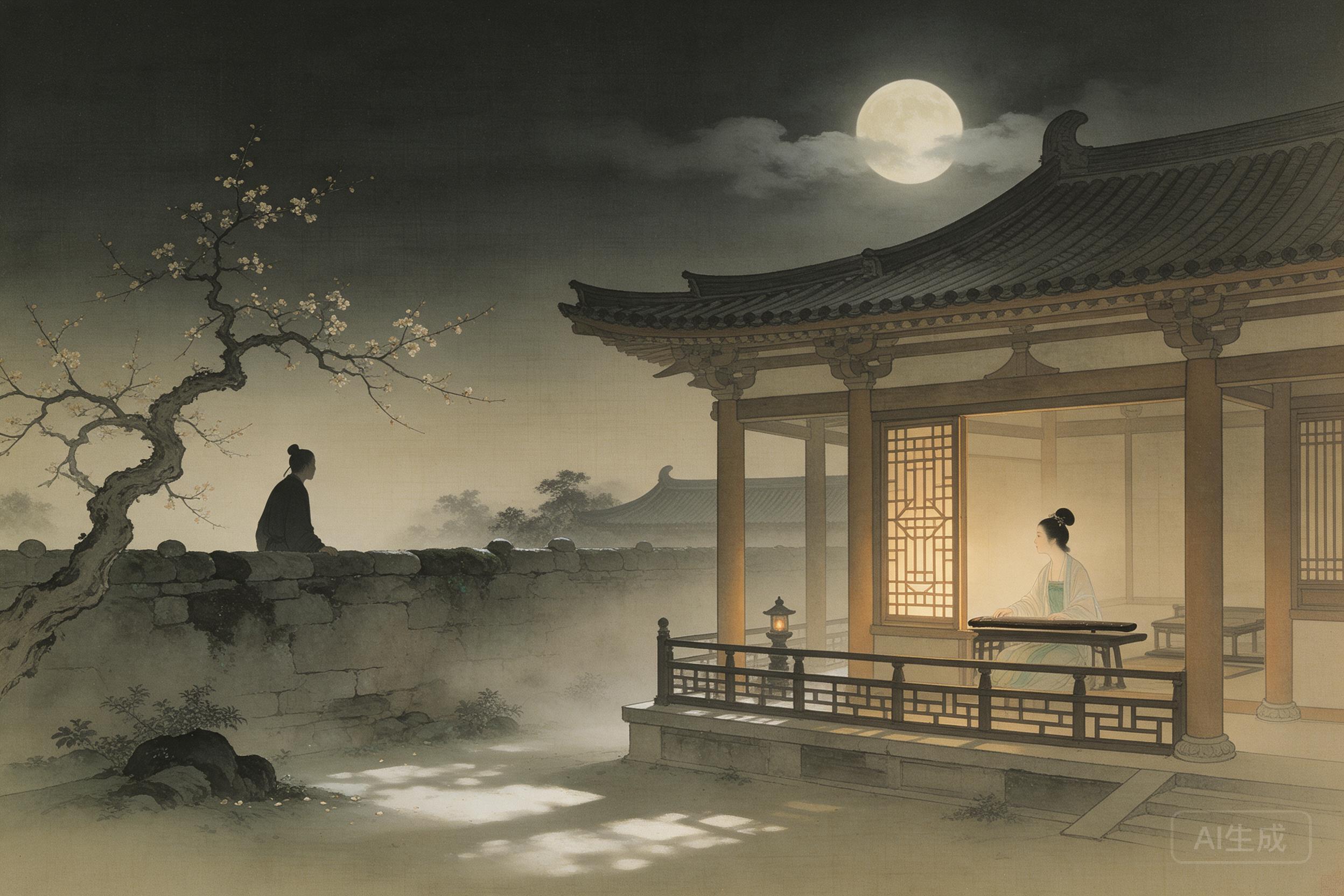
A poem goes out, and a quatrain comes back telling him to wait below the west wing, where the lattice stands half open. He takes it literally, climbs over the wall, and finds her formally dressed and upright. He saved her family, she says, and now answers one disorder with another. She asks him to keep to the rites, and goes. Some nights later Hongniang brings her mistress, who stays until the temple bell without speaking. He rides to Chang'an, returns to Pu, and leaves again for the examinations; on the last night she has the qin brought out and breaks off a few notes into the Nishang yuyi prelude, unable to go on. He sits the examinations twice, failing the second, and her long answer to his letter arrives with a jade ring, tangled silk and a bamboo tea roller.
05 A theory of dangerous beauty
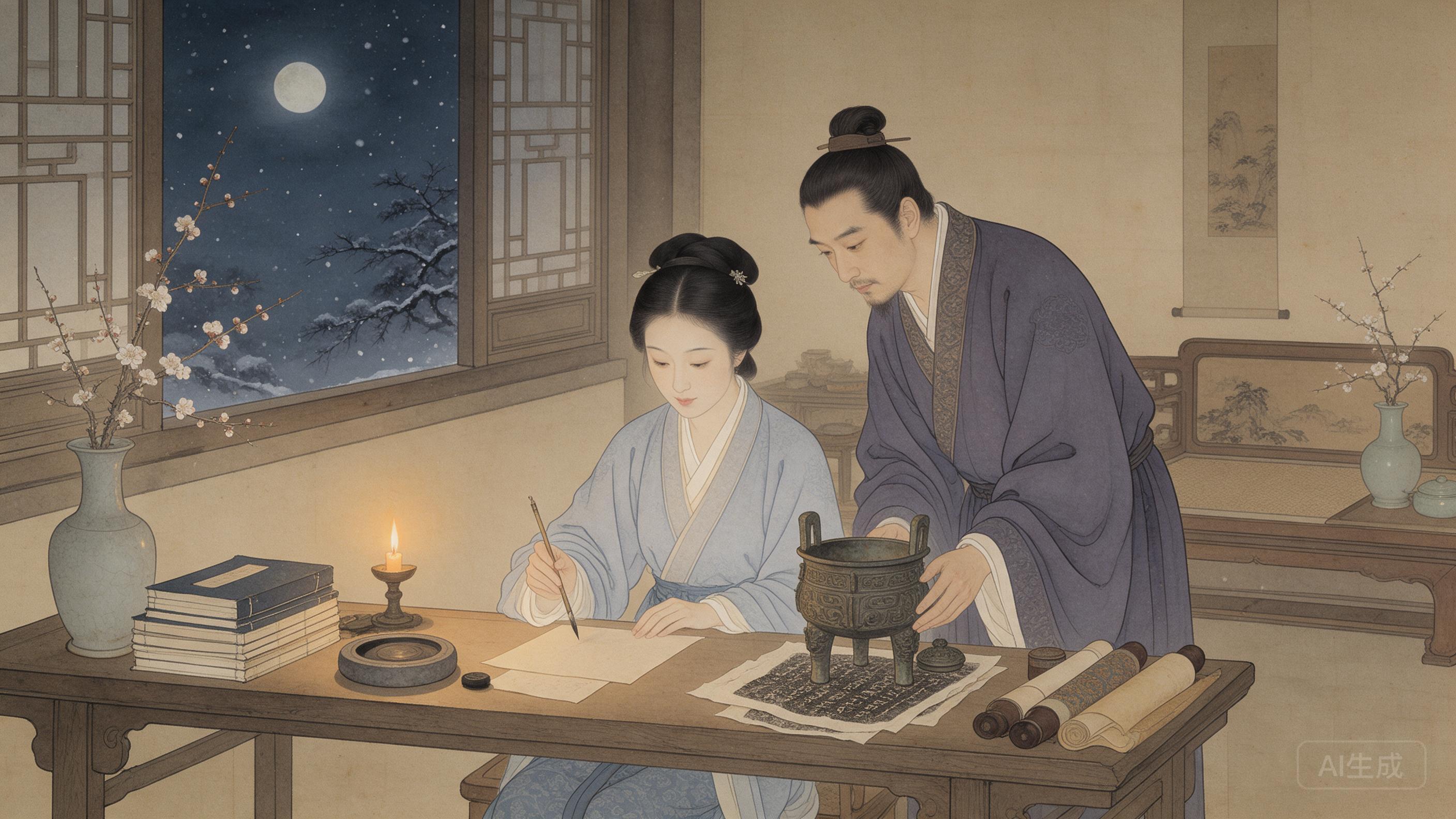
Her letter grants the case against him and asks nothing: 「始亂之,終棄之,固其宜矣,愚不敢恨。」(《太平廣記》卷四八八〈鶯鶯傳〉)——"To begin it in disorder and in the end to cast me off — such is indeed fitting; I dare not resent it." Yuan Zhen, named in the text, adds thirty rhymes to Zhang's verses. Zhang explains himself: heaven-born beauty either ruins itself or ruins others. 「予之德不足以勝妖孽,是用忍情。」(《太平廣記》卷四八八〈鶯鶯傳〉)——"My virtue is not sufficient to master a bewitching creature; therefore I restrained my feeling." The two marry other people. A year or more later he asks to see her as an elder cousin; she answers that she will not rise for other people's eyes, and never sees him again. He replies by giving his old feeling to the person in front of him; opinion, the narrator notes, praised him for mending his fault. It was the poet Li Shen, hearing the affair at Yuan Zhen's house in the ninth month of a Zhenyuan year, whose ballad named the tale.
06 The ending rewritten
Wang Shifu's Yuan-dynasty play Xixiang ji, The Western Wing, retells the courtship to the opposite conclusion: the lovers marry, Zhang Sheng gains the name Zhang Gong and the courtesy name Junrui, and Hongniang becomes the engine of the plot. Song readers already questioned its authorship: a preface of the age says the tale was absent from his collected works. Many since have held it to be his own experience, names changed; Wang Xingzhi's Chuanqi bianzheng reasoned from Yuan Zhen's chronology and an epitaph for a Zheng aunt that it was "entirely Weizhi's own account, merely borrowing another surname," and he gives Zhang's age as twenty-two where the received text reads twenty-three. That is a traditional reading with textual grounds, not a settled one.
Sources & further reading
Editorial approach