"Moonlit Night" is one of the most admired short poems in Chinese and one of the easiest to over-read. This essay follows its eight lines closely, then separates what the text says from the biography later readers have built around it.
Version and reliability: the eight lines quoted here follow the received text printed in the anthology Three Hundred Tang Poems and reproduced on Wikisource. This essay follows that text and does not collate editions; the attribution to Du Fu is not in dispute. The setting in the An Lushan rebellion is a traditional chronology. The New Tang History (eleventh century) records that Du Fu's family was at Fuzhou and that he was captured by rebels and escaped in 757, but it does not mention this poem. The link between poem and biography was drawn by later editors. The date of composition, the children's number and ages, whether the moonlit scene was observed or imagined, and whether the woman is certainly the wife are all interpretations or unknowns. This essay keeps the poem's words, the traditional reading, and the uncertainties separate.
The Poem
今夜鄜州月,闺中只独看。 遥怜小儿女,未解忆长安。 香雾云鬟湿,清辉玉臂寒。 何时倚虚幌,双照泪痕干。
Literal meaning: tonight the moon over Fuzhou; in the women's quarters one person watches alone. From afar I pity the small children, who do not yet understand remembering Chang'an. Fragrant mist wets her cloudlike hair; clear light chills her jade arms. When will we lean by the thin curtain, both shone upon, our tears dry?
It is a five-character regulated verse: eight lines, four couplets, parallel phrasing in the middle two. The vocabulary is ordinary; the use of it is not.
The Gaze Turned Around
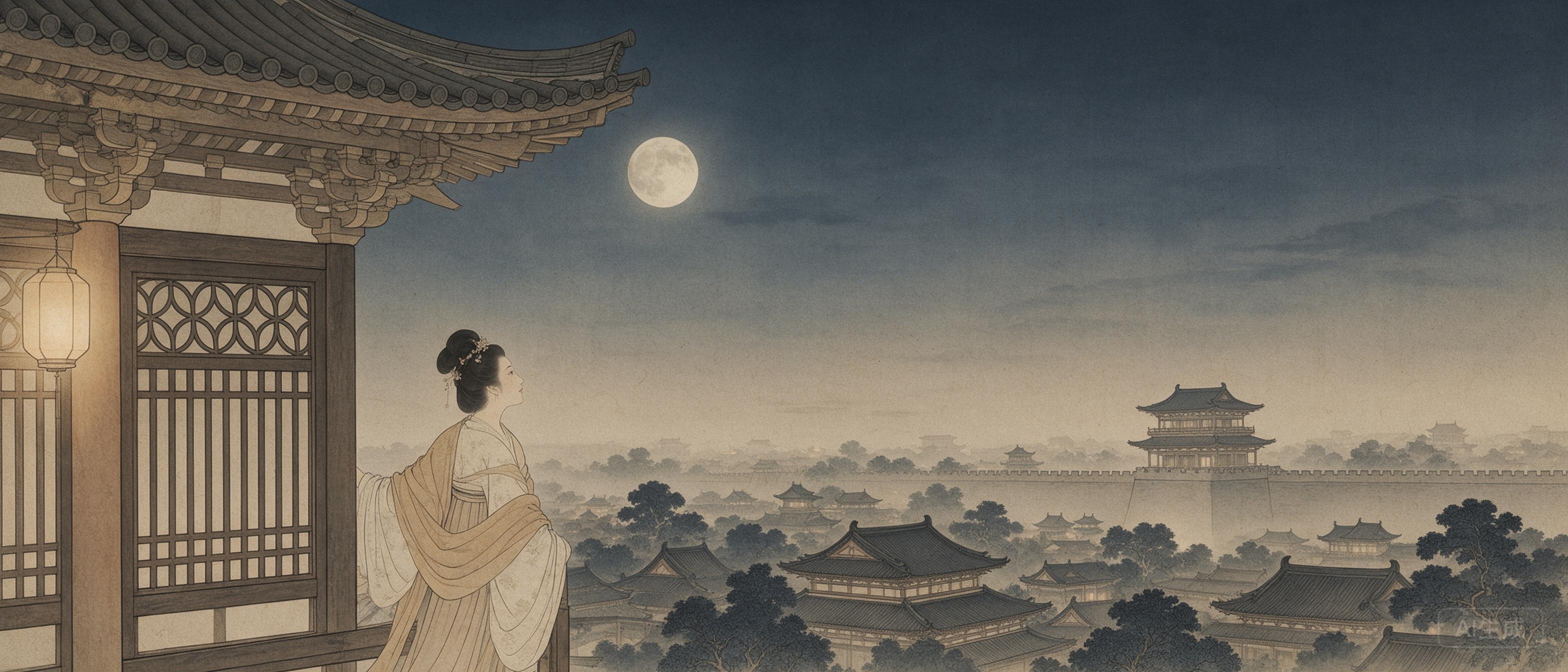
The poem opens on the moon over Fuzhou, not the moon over Chang'an, and not the poet. Fuzhou is where his family is; Chang'an is where he is. In the usual reading, the woman watching alone in the women's quarters is his wife. He sees her seeing the moon, and the first thing he gives her is solitude.
Then the children: he pities them because they do not yet understand remembering Chang'an. They are too young to know their father is far away, or too young to share the adult work of missing him. Either way, their incomprehension measures the distance. The word that carries the whole separation means nothing to them yet.
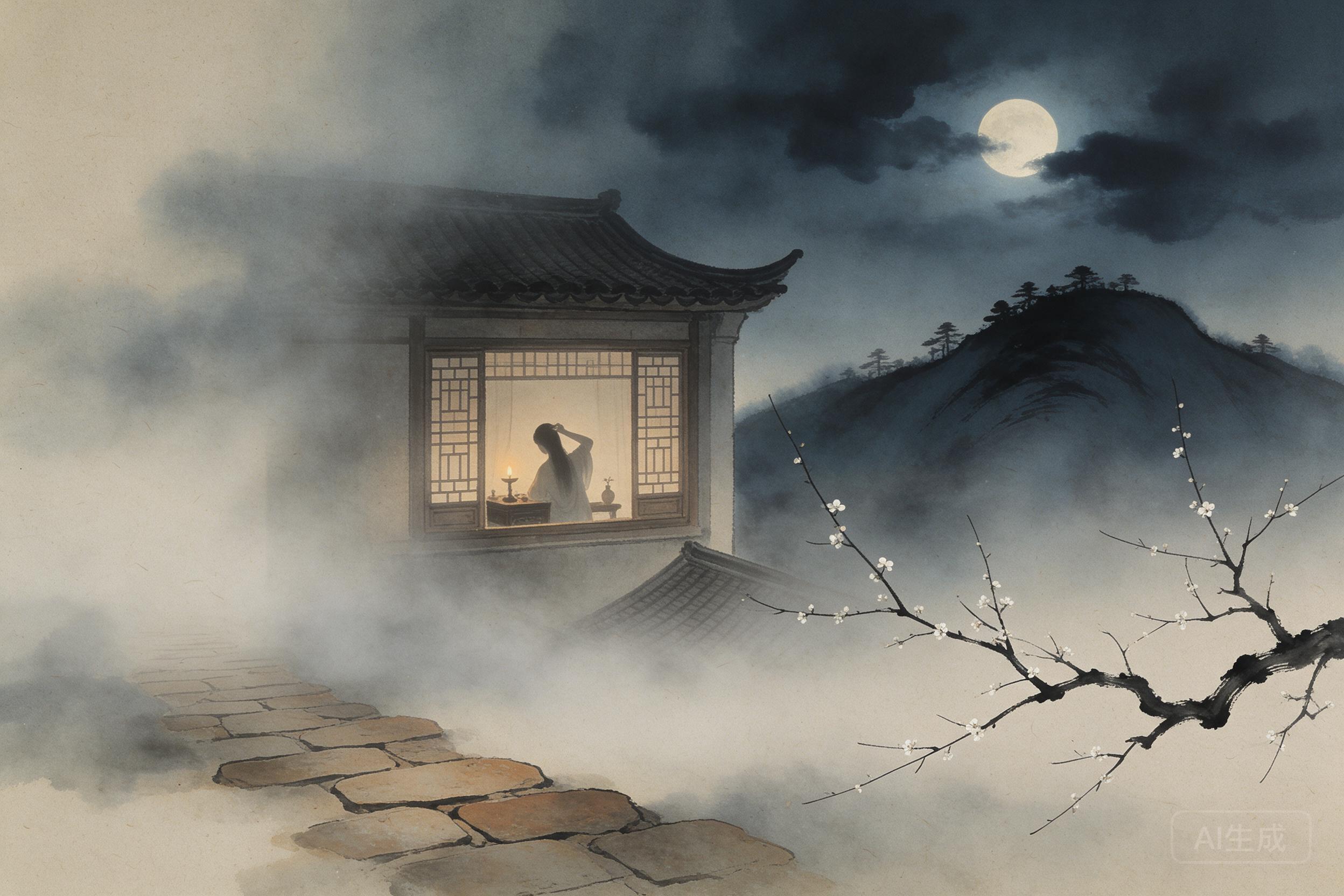
The next couplet is the most physical. Fragrant mist dampens her cloudlike hair; moonlight chills her jade arms. He is not looking at her. The detail is imagined, and its precision is the point: he knows how she would stand, how long she would stay, what the night would do to her hair and skin. Wet and cold are durations, not sensations.
Chinese readers have long called this writing from the opposite side: instead of reporting his own longing, the poet lends it to someone else and lets her stand in the moonlight for him. The effect is not to displace his feeling but to double it: one moon, two viewers, neither described directly.
What "Both Shine" Holds
The last couplet turns to the future: when will we lean by the thin curtain, both shone upon, our tear stains dry? The question is unanswered, perhaps unanswerable; the poem ends inside it.
"Both shone upon" is the hinge. Until now the moon has lit one watcher at a time; the hope is a single light falling on two people in one place. The tears are wet now and dry in the imagined future, and it is not clear whether the moon dries them or the reunion does. The thin curtain may be a window hanging or a bed curtain; even the hoped-for setting stays slightly open.
Where the Evidence Stops
The words can be checked. The eight lines follow the received text printed in the anthology Three Hundred Tang Poems and reproduced on Wikisource; the attribution to Du Fu and the five-character form are not in dispute.
The circumstances are a different kind of claim. The New Tang History, compiled in the eleventh century, says that after Emperor Suzong took the throne in 756 Du Fu tried to reach the court from Fuzhou, was captured by the rebels, and in 757 escaped to Fengxiang. It adds that his family lived at Fuzhou in poverty. That is a history, not a record of this poem: it never mentions Moonlit Night. The usual placing of the poem in the Chang'an captivity comes from later editors, who combined the poet's own works, above all Spring View and Return to Qiang Village, with the historical outline. It is a reasonable reconstruction, not a dated document.
Several things remain uncertain. The exact year and month of composition are not recorded; the common assignation to the autumn of 756 is editorial tradition. Whether the wife's vigil is remembered, reported in a letter, or entirely imagined cannot be determined. The number, names, and ages of the children are not fixed by this poem. Whether "the women's quarters" must mean the wife is an interpretive choice, though the usual one. The scene itself, the mist, the wet hair, the cold arms, may be observed, remembered, or invented; the poem does not say which.
A Moon With Two Viewers
Read as autobiography, the poem becomes a report and loses its design. Read as pure invention, it loses the pressure of the historical moment. What survives is the structure: a man in an occupied capital, in the traditional reading, imagining a woman in a courtyard, both under one moon, neither able to see the other. The poem needs only the second viewer, and it has her.
Sources & further reading
- Du Fu, Moonlit Night (Yueye), received text in the Three Hundred Tang Poems tradition (Wikisource, Chinese)
- Du Fu, Spring View (Chunwang), Chinese text (Wikisource)
- Du Fu, Return to Qiang Village (Qiangcun), Chinese text (Wikisource)
- New Tang History, juan 201, biography of Du Fu (Wikisource, Chinese)
- Du Fu, Chinese Wikipedia biographical entry (background and traditional chronology)